Portal:Classical music
The Classical Music Portal


Classical music generally refers to the art music of the Western world, considered to be distinct from Western folk music or popular music traditions. It is sometimes distinguished as Western classical music, as the term "classical music" can also be applied to non-Western art musics. Classical music is often characterized by formality and complexity in its musical form and harmonic organization, particularly with the use of polyphony. Since at least the ninth century it has been primarily a written tradition, spawning a sophisticated notational system, as well as accompanying literature in analytical, critical, historiographical, musicological and philosophical practices. A foundational component of Western culture, classical music is frequently seen from the perspective of individual or groups of composers, whose compositions, personalities and beliefs have fundamentally shaped its history. (Full article...)
Selected articles -
-
![Image 1 Mussorgsky, c. 1870 Modest Petrovich Mussorgsky (Russian: Модест Петрович Мусоргский, romanized: Modest Petrovich Musorgsky, IPA: [mɐˈdɛst pʲɪˈtrovʲɪtɕ ˈmusərkskʲɪj] ⓘ; 21 March [O.S. 9 March] 1839 – 28 March [O.S. 16 March] 1881) was a Russian composer, one of the group known as "The Five." He was an innovator of Russian music in the Romantic period. He strove to achieve a uniquely Russian musical identity, often in deliberate defiance of the established conventions of Western music. Many of his works were inspired by Russian history, Russian folklore, and other national themes. Such works include the opera Boris Godunov, the orchestral tone poem Night on Bald Mountain and the piano suite Pictures at an Exhibition. (Full article...)](//upload.wikimedia.org/wikipedia/en/d/d2/Blank.png)
 Mussorgsky, c. 1870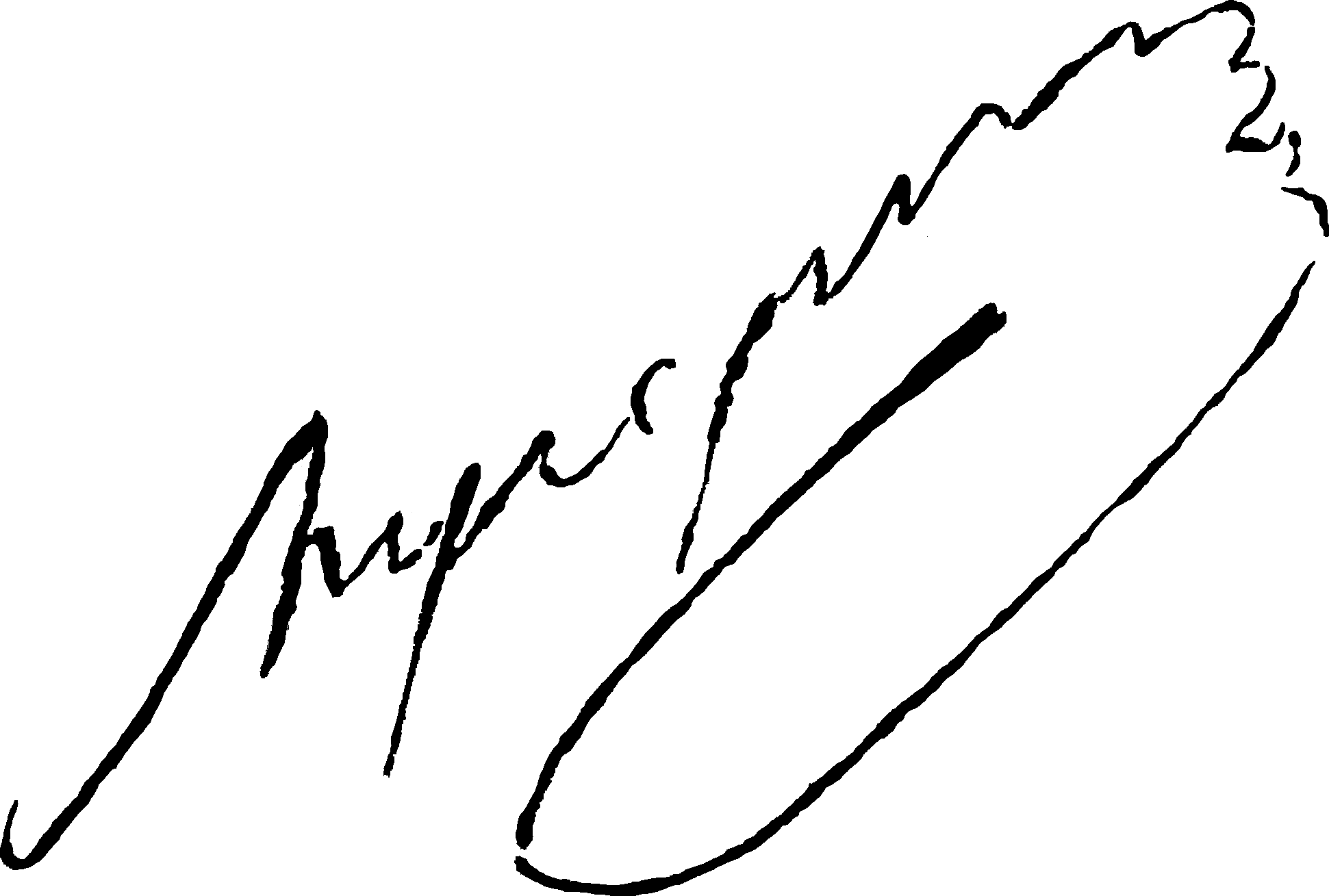
Modest Petrovich Mussorgsky (Russian: Модест Петрович Мусоргский, romanized: Modest Petrovich Musorgsky, IPA: [mɐˈdɛst pʲɪˈtrovʲɪtɕ ˈmusərkskʲɪj] ⓘ; 21 March [O.S. 9 March] 1839 – 28 March [O.S. 16 March] 1881) was a Russian composer, one of the group known as "The Five." He was an innovator of Russian music in the Romantic period. He strove to achieve a uniquely Russian musical identity, often in deliberate defiance of the established conventions of Western music.
Many of his works were inspired by Russian history, Russian folklore, and other national themes. Such works include the opera Boris Godunov, the orchestral tone poem Night on Bald Mountain and the piano suite Pictures at an Exhibition. (Full article...) -
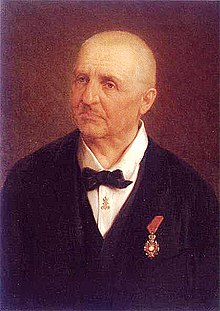
Joseph Anton Bruckner (German: [ˈantoːn ˈbʁʊknɐ] ⓘ; 4 September 1824 – 11 October 1896) was an Austrian composer and organist best known for his symphonies and sacred music, which includes Masses, Te Deum and motets. The symphonies are considered emblematic of the final stage of Austro-German Romanticism because of their rich harmonic language, strongly polyphonic character, and considerable length. Bruckner's compositions helped to define contemporary musical radicalism, owing to their dissonances, unprepared modulations, and roving harmonies.
Unlike other musical radicals such as Richard Wagner and Hugo Wolf, Bruckner showed respect, even humility, before other famous musicians, Wagner in particular. This apparent dichotomy between Bruckner the man and Bruckner the composer hampers efforts to describe his life in a way that gives a straightforward context for his music. Hans von Bülow described him as "half genius, half simpleton". Bruckner was critical of his own work and often reworked his compositions. There are several versions of many of his works. (Full article...) -
Antonio Lucio Vivaldi (4 March 1678 – 28 July 1741) was an Italian composer, virtuoso violinist and impresario of Baroque music. Along with Johann Sebastian Bach and George Frideric Handel, Vivaldi ranks amongst the greatest Baroque composers and his influence during his lifetime was widespread across Europe, giving origin to many imitators and admirers. He pioneered many developments in orchestration, violin technique and programmatic music. He consolidated the emerging concerto form into a widely accepted and followed idiom.
Vivaldi composed many instrumental concertos, for the violin and a variety of other musical instruments, as well as sacred choral works and more than fifty operas. His best-known work is a series of violin concertos known as The Four Seasons. Many of his compositions were written for the all-female music ensemble of the Ospedale della Pietà, a home for abandoned children. Vivaldi began studying for the priesthood at the age of 15 and was ordained at 25, but was given dispensation to no longer say public Masses due to a health problem. Vivaldi also had some success with expensive stagings of his operas in Venice, Mantua and Vienna. After meeting the Emperor Charles VI, Vivaldi moved to Vienna, hoping for royal support. However, the Emperor died soon after Vivaldi's arrival, and Vivaldi himself died in poverty less than a year later. (Full article...) -
La traviata (Italian: [la traviˈaːta, -aˈvjaː-]; The Fallen Woman) is an opera in three acts by Giuseppe Verdi set to an Italian libretto by Francesco Maria Piave. It is based on La Dame aux camélias (1852), a play by Alexandre Dumas fils, which he adapted from his own 1848 novel. The opera was originally titled Violetta, after the main character. It was first performed on 6 March 1853 at La Fenice opera house in Venice.
Piave and Verdi wanted to follow Dumas in giving the opera a contemporary setting, but the authorities at La Fenice insisted that it be set in the past, "c. 1700". It was not until the 1880s that the composer's and librettist's original wishes were carried out and "realistic" productions were staged. La traviata has become immensely popular and is among the most frequently performed of all operas. (Full article...) -

The xylophone (from Ancient Greek ξύλον (xúlon) 'wood' and φωνή (phōnḗ) 'sound, voice'; lit. 'sound of wood') is a musical instrument in the percussion family that consists of wooden bars struck by mallets. Each bar is an idiophone tuned to a pitch of a musical scale, whether pentatonic or heptatonic in the case of many African and Asian instruments, diatonic in many western children's instruments, or chromatic for orchestral use.
The term xylophone may be used generally, to include all such instruments such as the marimba, balafon and even the semantron. However, in the orchestra, the term xylophone refers specifically to a chromatic instrument of somewhat higher pitch range and drier timbre than the marimba, and these two instruments should not be confused. A person who plays the xylophone is known as a xylophonist or simply a xylophone player. (Full article...) -
Robert Schumann (German: [ˈʁoːbɛʁt ˈʃuːman]; 8 June 1810 – 29 July 1856) was a German composer, pianist, and music critic of the early Romantic era. He composed in all the main musical genres of the time, writing for solo piano, voice and piano, chamber groups, orchestra, choir and the opera. His works typify the spirit of the Romantic era in German music.
Schumann was born in Zwickau, Saxony, to an affluent middle-class family with no musical connections, and was initially unsure whether to pursue a career as a lawyer or to make a living as a pianist-composer. He studied law at the universities of Leipzig and Heidelberg but his main interests were music and Romantic literature. From 1829 he was a student of the piano teacher Friedrich Wieck, but his hopes for a career as a virtuoso pianist were frustrated by a worsening problem with his right hand, and he concentrated on composition. His early works were mainly piano pieces, including the large-scale Carnaval, Davidsbündlertänze (Dances of the League of David), Fantasiestücke (Fantasy Pieces), Kreisleriana and Kinderszenen (Scenes from Childhood) (1834–1838). He was a co-founder of the Neue Zeitschrift für Musik (New Musical Journal) in 1834 and edited it for ten years. In his writing for the journal and in his music he distinguished between two contrasting aspects of his personality, dubbing these alter egos "Florestan" for his impetuous self and "Eusebius" for his gentle poetic side. (Full article...) -
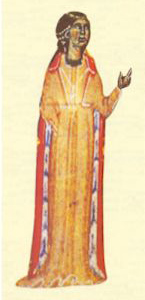
A medieval depiction of Comtessa de Diá
The trobairitz (Occitan pronunciation: [tɾuβajˈɾits]) were Occitan female troubadours of the 12th and 13th centuries, active from around 1170 to approximately 1260. Trobairitz is both singular and plural.
The word trobairitz is first attested in the 13th-century romance Flamenca. It comes from the Provençal word trobar, the literal meaning of which is "to find", and the technical meaning of which is "to compose". The word trobairitz is used very rarely in medieval Occitan, as it does not occur in lyrical poetry, grammatical treatises or in the biographies (vidas) of the trobairitz or troubadours. It does occur in the treatise Doctrina d'acort by Terramagnino da Pisa, written between 1282 and 1296. He uses it as an example of a word the plural and singular of which are the same. (Full article...) -
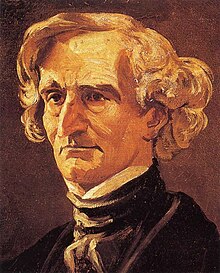
Hector Berlioz was the first to use the term "choral symphony" for a musical composition—his Roméo et Juliette.
A choral symphony is a musical composition for orchestra, choir, and sometimes solo vocalists that, in its internal workings and overall musical architecture, adheres broadly to symphonic musical form. The term "choral symphony" in this context was coined by Hector Berlioz when he described his Roméo et Juliette as such in his five-paragraph introduction to that work. The direct antecedent for the choral symphony is Ludwig van Beethoven's Ninth Symphony. Beethoven's Ninth incorporates part of the ode An die Freude ("Ode to Joy"), a poem by Friedrich Schiller, with text sung by soloists and chorus in the last movement. It is the first example of a major composer's use of the human voice on the same level as instruments in a symphony.
A few 19th-century composers, notably Felix Mendelssohn and Franz Liszt, followed Beethoven in producing choral symphonic works. Notable works in the genre were produced in the 20th century by Gustav Mahler, Igor Stravinsky, Ralph Vaughan Williams, Benjamin Britten and Dmitri Shostakovich, among others. The final years of the 20th century and the opening of the 21st century have seen several new works in this genre, among them compositions by Mikis Theodorakis, Peter Maxwell Davies, Tan Dun, Philip Glass, Hans Werner Henze, Krzysztof Penderecki, William Bolcom and Robert Strassburg. (Full article...) -
"The Blue Danube" is the common English title of "An der schönen blauen Donau", Op. 314 (German for "By the Beautiful Blue Danube"), a waltz by the Austrian composer Johann Strauss II, composed in 1866. Originally performed on 15 February 1867 at a concert of the Wiener Männergesang-Verein (Vienna Men's Choral Association), it has been one of the most consistently popular pieces of music in the classical repertoire. Its initial performance was considered only a mild success, however, and Strauss is reputed to have said, "The devil take the waltz, my only regret is for the coda—I wish that had been a success!"
After the original music was written, the words were added by the Choral Association's poet, Joseph Weyl. Strauss later added more music, and Weyl needed to change some of the words. Strauss adapted it into a purely orchestral version for the 1867 Paris World's Fair, and it became a great success in this form. The instrumental version is by far the most commonly performed today. An alternate text was written by Franz von Gernerth, "Donau so blau" (Danube so blue). "The Blue Danube" premiered in the United States in its instrumental version on 1 July 1867 in New York, and in the UK in its choral version on 21 September 1867 in London at the promenade concerts at Covent Garden. (Full article...) -
Symphony No. 40 in G minor, K. 550 was written by Wolfgang Amadeus Mozart in 1788. It is sometimes referred to as the "Great G minor symphony", to distinguish it from the "Little G minor symphony", No. 25. The two are the only extant minor key among Mozart's symphonies. (Full article...) -
Madama Butterfly (Italian pronunciation: [maˈdaːma ˈbatterflai]; Madame Butterfly) is an opera in three acts (originally two) by Giacomo Puccini, with an Italian libretto by Luigi Illica and Giuseppe Giacosa.
It is based on the short story "Madame Butterfly" (1898) by John Luther Long, which in turn was based on stories told to Long by his sister Jennie Correll and on the semi-autobiographical 1887 French novel Madame Chrysanthème by Pierre Loti. Long's version was dramatized by David Belasco as the one-act play Madame Butterfly: A Tragedy of Japan, which, after premiering in New York in 1900, moved to London, where Puccini saw it in the summer of that year. (Full article...) -

The six-part fugue in the "Ricercar a 6" from The Musical Offering, in the hand of Johann Sebastian Bach
In classical music, a fugue (/fjuːɡ/, from Latin fuga, meaning "flight" or "escape") is a contrapuntal, polyphonic compositional technique in two or more voices, built on a subject (a musical theme) that is introduced at the beginning in imitation (repetition at different pitches), which recurs frequently throughout the course of the composition. It is not to be confused with a fuguing tune, which is a style of song popularized by and mostly limited to early American (i.e. shape note or "Sacred Harp") music and West Gallery music. A fugue usually has three main sections: an exposition, a development, and a final entry that contains the return of the subject in the fugue's tonic key. Fugues can also have episodes, which are parts of the fugue where new material often based on the subject is heard; a stretto (plural stretti), when the fugue's subject overlaps itself in different voices, or a recapitulation. A popular compositional technique in the Baroque era, the fugue was fundamental in showing mastery of harmony and tonality as it presented counterpoint.
In the Middle Ages, the term was widely used to denote any works in canonic style; however, by the Renaissance, it had come to denote specifically imitative works. Since the 17th century, the term fugue has described what is commonly regarded as the most fully developed procedure of imitative counterpoint. (Full article...)
![Image 1 Mussorgsky, c. 1870 Modest Petrovich Mussorgsky (Russian: Модест Петрович Мусоргский, romanized: Modest Petrovich Musorgsky, IPA: [mɐˈdɛst pʲɪˈtrovʲɪtɕ ˈmusərkskʲɪj] ⓘ; 21 March [O.S. 9 March] 1839 – 28 March [O.S. 16 March] 1881) was a Russian composer, one of the group known as "The Five." He was an innovator of Russian music in the Romantic period. He strove to achieve a uniquely Russian musical identity, often in deliberate defiance of the established conventions of Western music. Many of his works were inspired by Russian history, Russian folklore, and other national themes. Such works include the opera Boris Godunov, the orchestral tone poem Night on Bald Mountain and the piano suite Pictures at an Exhibition. (Full article...)](http://upload.wikimedia.org/wikipedia/en/d/d2/Blank.png)

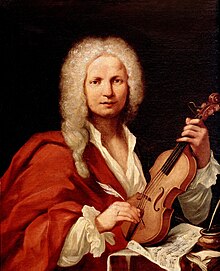


General images -
-
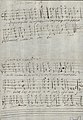 Individual sheet music for a seventeenth-century harp. (from Baroque music)
 -
 1875 oil painting of Franz Schubert by Wilhelm August Rieder, after his own 1825 watercolor portrait (from Classical period (music))
 -
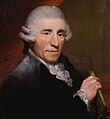 Haydn portrait by Thomas Hardy, 1792 (from Classical period (music))
 -
 Gustav Mahler, photographed in 1907 by Moritz Nähr at the end of his period as director of the Vienna Hofoper (from Romantic music)
 -
 Josef Danhauser's 1840 painting of Franz Liszt at the piano surrounded by (from left to right) Alexandre Dumas, Hector Berlioz, George Sand, Niccolò Paganini, Gioachino Rossini and Marie d'Agoult, with a bust of Ludwig van Beethoven on the piano (from Romantic music)
 -
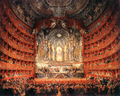 A large instrumental ensemble's performance in the lavish Teatro Argentina, as depicted by Panini (1747) (from Baroque music)
 -
 A young Wolfgang Amadeus Mozart, a representative composer of the Classical period, seated at a keyboard. (from Classical period (music))
 -
 Portion of Du Fay's setting of Ave maris stella, in fauxbourdon. The top line is a paraphrase of the chant; the middle line, designated "fauxbourdon", (not written) follows the top line but exactly a perfect fourth below. The bottom line is often, but not always, a sixth below the top line; it is embellished, and reaches cadences on the octave.Play (from Renaissance music)
 -
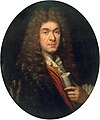
-
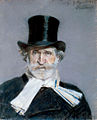
-
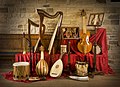 Selection of Renaissance instruments (from Renaissance music)
 -
 The opening bars of the Commendatore's aria in Mozart's opera Don Giovanni. The orchestra starts with a dissonant diminished seventh chord (G# dim7 with a B in the bass) moving to a dominant seventh chord (A7 with a C# in the bass) before resolving to the tonic chord (D minor) at the singer's entrance. (from Classical period (music))
 -
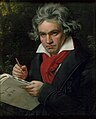 Portrait of Beethoven, 1820 (from Classical period (music))
 -

-
 Richard Wagner in Paris, 1861
 -
 Johann Sebastian Bach, 1748 (from Baroque music)
 -
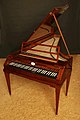 Fortepiano by Paul McNulty after Walter & Sohn, c. 1805 (from Classical period (music))
 -
-
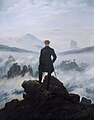 Wanderer above the Sea of Fog, by Caspar David Friedrich, is an example of Romantic painting. (from Romantic music)
 -
 Franz Liszt in 1858 by Franz Hanfstaengl (from Romantic music)
 -
 Double-manual harpsichord by Vital Julian Frey, after Jean-Claude Goujon (1749) (from Baroque music)
 -
 Hummel in 1814 (from Classical period (music))
 -
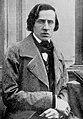 Daguerreotype of Chopin, c. 1849 (from Romantic music)
 -
 Wolfgang Amadeus Mozart, posthumous painting by Barbara Krafft in 1819 (from Classical period (music))
 -
 Balakirev (top), Cui (upper left), Mussorgsky (upper right), Rimsky-Korsakov (lower left), and Borodin (lower right). (from Romantic music)
 -
 Musicians from 'Procession in honour of Our Lady of Sablon in Brussels.' Early 17th-century Flemish alta cappella. From left to right: bass dulcian, alto shawm, treble cornett, soprano shawm, alto shawm, tenor sackbut. (from Renaissance music)
 -
 Gluck, detail of a portrait by Joseph Duplessis, dated 1775 (Kunsthistorisches Museum, Vienna) (from Classical period (music))
 -
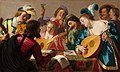 Gerard van Honthorst, The Concert (1623), National Gallery of Art, Washington D.C. (from Renaissance music)
 -
 Bizet photographed by Étienne Carjat (1875) (from Romantic music)
 -
 Bernhard Crusell, a Swedish-Finnish composer and clarinetist, in 1826 (from Classical period (music))
 -
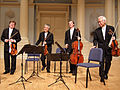 A modern string quartet. In the 2000s, string quartets from the Classical era are the core of the chamber music literature. From left to right: violin 1, violin 2, cello, viola (from Classical period (music))
 -
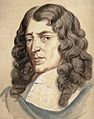 Marc-Antoine Charpentier (from Baroque music)
 -
 Painting by Evaristo Baschenis of Baroque instruments, including a cittern, viola da gamba, violin, and two lutes (from Baroque music)
 -
 Claudio Monteverdi in 1640 (from Baroque music)
 -
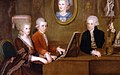 The Mozart family c. 1780. The portrait on the wall is of Mozart's mother. (from Classical period (music))
 -

-
 View of Vienna in 1758, by Bernardo Bellotto (from Classical period (music))
 -


Quotes -
Related portals


WikiProjects


 Selected composers -


-
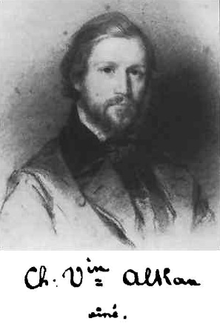
Charles-Valentin Alkan, c. 1835. Portrait by Édouard Dubufe
Charles-Valentin Alkan (French: [ʃaʁl valɑ̃tɛ̃ alkɑ̃]; 30 November 1813 – 29 March 1888) was a French composer and virtuoso pianist. At the height of his fame in the 1830s and 1840s he was, alongside his friends and colleagues Frédéric Chopin and Franz Liszt, among the leading pianists in Paris, a city in which he spent virtually his entire life.
Alkan earned many awards at the Conservatoire de Paris, which he entered before he was six. His career in the salons and concert halls of Paris was marked by his occasional long withdrawals from public performance, for personal reasons. Although he had a wide circle of friends and acquaintances in the Parisian artistic world, including Eugène Delacroix and George Sand, from 1848 he began to adopt a reclusive life style, while continuing with his compositions – virtually all of which are for the keyboard. During this period he published, among other works, his collections of large-scale studies in all the major keys (Op. 35) and all the minor keys (Op. 39). The latter includes his Symphony for Solo Piano (Op. 39, nos. 4–7) and Concerto for Solo Piano (Op. 39, nos. 8–10), which are often considered among his masterpieces and are of great musical and technical complexity. Alkan emerged from self-imposed retirement in the 1870s to give a series of recitals that were attended by a new generation of French musicians. (Full article...) -
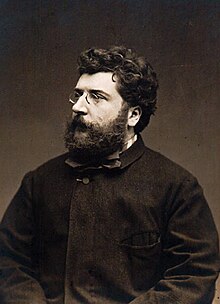
Bizet photographed by Étienne Carjat (1875)
Georges Bizet (né Alexandre César Léopold Bizet; 25 October 1838 – 3 June 1875) was a French composer of the Romantic era. Best known for his operas in a career cut short by his early death, Bizet achieved few successes before his final work, Carmen, which has become one of the most popular and frequently performed works in the entire opera repertoire.
During a brilliant student career at the Conservatoire de Paris, Bizet won many prizes, including the prestigious Prix de Rome in 1857. He was recognised as an outstanding pianist, though he chose not to capitalise on this skill and rarely performed in public. Returning to Paris after almost three years in Italy, he found that the main Parisian opera theatres preferred the established classical repertoire to the works of newcomers. His keyboard and orchestral compositions were likewise largely ignored; as a result, his career stalled, and he earned his living mainly by arranging and transcribing the music of others. Restless for success, he began many theatrical projects during the 1860s, most of which were abandoned. Neither of his two operas that reached the stage in this time—Les pêcheurs de perles and La jolie fille de Perth—were immediately successful. (Full article...) -

A 1611 woodcut of Josquin des Prez, possibly copied from a now-lost oil painting made during his lifetime. There have been doubts concerning whether this depiction is an accurate likeness, see § Portraits.
Josquin Lebloitte dit des Prez (c. 1450–1455 – 27 August 1521) was a composer of High Renaissance music, who is variously described as French or Franco-Flemish. Considered one of the greatest composers of the Renaissance, he was a central figure of the Franco-Flemish School and had a profound influence on the music of 16th-century Europe. Building on the work of his predecessors Guillaume Du Fay and Johannes Ockeghem, he developed a complex style of expressive—and often imitative—movement between independent voices (polyphony) which informs much of his work. He further emphasized the relationship between text and music, and departed from the early Renaissance tendency towards lengthy melismatic lines on a single syllable, preferring to use shorter, repeated motifs between voices. Josquin was a singer, and his compositions are mainly vocal. They include masses, motets and secular chansons.
Josquin's biography has been continually revised by modern scholarship, and remains highly uncertain. Little is known of his early years; he was born in the French-speaking area of Flanders, and he may have been an altar boy and have been educated at the Cambrai Cathedral, or taught by Ockeghem. By 1477 he was in the choir of René of Anjou and then probably served under Louis XI of France. Now a wealthy man, in the 1480s Josquin traveled Italy with the Cardinal Ascanio Sforza, may have worked in Vienna for the Hungarian king Matthias Corvinus, and wrote the motet Ave Maria ... Virgo serena, and the popular chansons Adieu mes amours and Que vous ma dame. He served Pope Innocent VIII and Pope Alexander VI in Rome, Louis XII in France, and Ercole I d'Este in Ferrara. Many of his works were printed and published by Ottaviano Petrucci in the early 16th century, including the Missa Hercules Dux Ferrariae. In his final years in Condé, Josquin produced some of his most admired works, including the masses Missa de Beata Virgine and Missa Pange lingua; the motets Benedicta es, Inviolata, Pater noster–Ave Maria and Praeter rerum seriem; and the chansons Mille regretz, Nimphes, nappés and Plus nulz regretz. (Full article...) -
Pyotr Ilyich Tchaikovsky (/tʃaɪˈkɒfski/ chy-KOF-skee; 7 May 1840 – 6 November 1893) was a Russian composer during the Romantic period. He was the first Russian composer whose music would make a lasting impression internationally. Tchaikovsky wrote some of the most popular concert and theatrical music in the current classical repertoire, including the ballets Swan Lake and The Nutcracker, the 1812 Overture, his First Piano Concerto, Violin Concerto, the Romeo and Juliet Overture-Fantasy, several symphonies, and the opera Eugene Onegin.
Although musically precocious, Tchaikovsky was educated for a career as a civil servant as there was little opportunity for a musical career in Russia at the time and no system of public music education. When an opportunity for such an education arose, he entered the nascent Saint Petersburg Conservatory, from which he graduated in 1865. The formal Western-oriented teaching that Tchaikovsky received there set him apart from composers of the contemporary nationalist movement embodied by the Russian composers of The Five with whom his professional relationship was mixed. (Full article...) -

Pyotr Ilyich Tchaikovsky (top left) and The Five (counter-clockwise from bottom left): Mily Balakirev, César Cui, Alexander Borodin, Modest Mussorgsky, and Nikolai Rimsky-Korsakov
In mid- to late-19th-century Russia, Pyotr Ilyich Tchaikovsky and a group of composers known as The Five had differing opinions as to whether Russian classical music should be composed following Western or native practices. Tchaikovsky wanted to write professional compositions of such quality that they would stand up to Western scrutiny and thus transcend national barriers, yet remain distinctively Russian in melody, rhythm and other compositional characteristics. The Five, made up of composers Mily Balakirev, Alexander Borodin, César Cui, Modest Mussorgsky, and Nikolai Rimsky-Korsakov, sought to produce a specifically Russian kind of art music, rather than one that imitated older European music or relied on European-style conservatory training. While Tchaikovsky himself used folk songs in some of his works, for the most part he tried to follow Western practices of composition, especially in terms of tonality and tonal progression. Also, unlike Tchaikovsky, none of The Five were academically trained in composition; in fact, their leader, Balakirev, considered academicism a threat to musical imagination. Along with critic Vladimir Stasov, who supported The Five, Balakirev attacked relentlessly both the Saint Petersburg Conservatory, from which Tchaikovsky had graduated, and its founder Anton Rubinstein, orally and in print.
As Tchaikovsky had become Rubinstein's best-known student, he was initially considered by association as a natural target for attack, especially as fodder for Cui's printed critical reviews. This attitude changed slightly when Rubinstein left the Saint Petersburg musical scene in 1867. In 1869 Tchaikovsky entered into a working relationship with Balakirev; the result was Tchaikovsky's first recognized masterpiece, the fantasy-overture Romeo and Juliet, a work which The Five wholeheartedly embraced. When Tchaikovsky wrote a positive review of Rimsky-Korsakov's Fantasy on Serbian Themes he was welcomed into the circle, despite concerns about the academic nature of his musical background. The finale of his Second Symphony, nicknamed the Little Russian, was also received enthusiastically by the group on its first performance in 1872. (Full article...) -

Cabinet card of Massenet by Eugène Pirou, 1895
Jules Émile Frédéric Massenet (French pronunciation: [ʒyl emil fʁedeʁik masnɛ]; 12 May 1842 – 13 August 1912) was a French composer of the Romantic era best known for his operas, of which he wrote more than thirty. The two most frequently staged are Manon (1884) and Werther (1892). He also composed oratorios, ballets, orchestral works, incidental music, piano pieces, songs and other music.
While still a schoolboy, Massenet was admitted to France's principal music college, the Paris Conservatoire. There he studied under Ambroise Thomas, whom he greatly admired. After winning the country's top musical prize, the Prix de Rome, in 1863, he composed prolifically in many genres, but quickly became best known for his operas. Between 1867 and his death forty-five years later he wrote more than forty stage works in a wide variety of styles, from opéra-comique to grand-scale depictions of classical myths, romantic comedies, lyric dramas, as well as oratorios, cantatas and ballets. Massenet had a good sense of the theatre and of what would succeed with the Parisian public. Despite some miscalculations, he produced a series of successes that made him the leading composer of opera in France in the late 19th and early 20th centuries. (Full article...) -
Leonard Joseph Tristano (March 19, 1919 – November 18, 1978) was an American jazz pianist, composer, arranger, and teacher of jazz improvisation.
Tristano studied for bachelor's and master's degrees in music in Chicago before moving to New York City in 1946. He played with leading bebop musicians and formed his own small bands, which soon displayed some of his early interests – contrapuntal interaction of instruments, harmonic flexibility, and rhythmic complexity. His quintet in 1949 recorded the first free group improvisations. Tristano's innovations continued in 1951, with the first overdubbed, improvised jazz recordings, and two years later, when he recorded an atonal improvised solo piano piece that was based on the development of motifs rather than on harmonies. He developed further via polyrhythms and chromaticism into the 1960s, but was infrequently recorded. (Full article...) -
Carl August Nielsen (Danish: [ˈkʰɑˀl ˈne̝lsn̩]; 9 June 1865 – 3 October 1931) was a Danish composer, conductor, and violinist, widely recognized as his country's most prominent composer.
Brought up by poor yet musically talented parents on the island of Funen, he demonstrated his musical abilities at an early age. He initially played in a military band before attending the Royal Danish Academy of Music in Copenhagen from 1884 until December 1886. He premiered his Op. 1, Suite for Strings, in 1888, at the age of 23. The following year, Nielsen began a 16-year stint as a second violinist in the Royal Danish Orchestra under the conductor Johan Svendsen, during which he played in Verdi's Falstaff and Otello at their Danish premieres. In 1916, he took a post teaching at the Royal Danish Academy and continued to work there until his death. (Full article...) -
Jeremy Soule (/soʊl/ SOHL; born December 19, 1975) is an American composer of soundtracks for film, television, and video games. He has composed soundtracks for over 60 games and over a dozen other works during his career, including The Elder Scrolls, Guild Wars, Icewind Dale, and the Harry Potter series.
He became an employee of Square in 1994 after several years of private composition studies. After finishing the soundtrack to Secret of Evermore in 1995, he left to join Humongous Entertainment, where he composed for several children's games as well as Total Annihilation, his first award-winning score. In 2000, he left to form his own music production company, Soule Media, later called Artistry Entertainment. In 2005, he founded DirectSong, a record label that published digital versions of his soundtracks as well as those of classical composers. DirectSong remained active until 2019. (Full article...) -

Top: Pyotr Ilyich Tchaikovsky. Bottom (left to right): Nikolai Rimsky-Korsakov, Alexander Glazunov and Anatoly Lyadov
Pyotr Ilyich Tchaikovsky's relations with the group of composers known as the Belyayev circle, which lasted from 1887 until Tchaikovsky's death in 1893, influenced all of their music and briefly helped shape the next generation of Russian composers. This group was named after timber merchant Mitrofan Belyayev, an amateur musician who became an influential music patron and publisher after he had taken an interest in Alexander Glazunov's work. By 1887, Tchaikovsky was firmly established as one of the leading composers in Russia. A favorite of Tsar Alexander III, he was widely regarded as a national treasure. He was in demand as a guest conductor in Russia and Western Europe, and in 1890 visited the United States in the same capacity. By contrast, the fortunes of the nationalistic group of composers known as The Five, which preceded the Belyayev circle, had waned, and the group had long since dispersed; of its members, only Nikolai Rimsky-Korsakov remained fully active as a composer. Now a professor of musical composition and orchestration at the Saint Petersburg Conservatory, Rimsky-Korsakov had become a firm believer in the Western-based compositional training that had been once frowned upon by the group.
As a result of the time Tchaikovsky spent with the Belyayev circle's leading composers—Glazunov, Anatoly Lyadov and Rimsky-Korsakov—the somewhat fraught relationship he had previously endured with The Five would eventually meld into something more harmonious. Tchaikovsky's friendship with these men gave him increased confidence in his own abilities as a composer, while his music encouraged Glazunov to broaden his artistic outlook past the nationalist agenda and to compose along more universal themes. This influence grew to the point that Glazunov's Third Symphony became known as the "anti-kuchist" symphony of his oeuvre ("kuchist" refers to "kuchka", the shortened Russian name for The Five) and shared several stylistic fingerprints with Tchaikovsky's later symphonies. Nor was Glazunov the only composer so influenced. Rimsky-Korsakov wrote about the Belyayev composers' "worship of Tchaikovsky and ... tendency toward eclecticism" that became prevalent during this period, along with a predilection toward "Italian-French music of the time of wig and farthingale" (that is, of the 18th Century) typified in Tchaikovsky's late operas The Queen of Spades and Iolanta. (Full article...) -
Leo Ornstein (born Lev Ornshteyn; Russian: Лев Орнштейн; c. December 11, 1895 – February 24, 2002) was an American experimental composer and pianist of the early twentieth century. His performances of works by avant-garde composers and his own innovative and even shocking pieces made him a cause célèbre on both sides of the Atlantic. The bulk of his experimental works were written for piano.
Ornstein was the first important composer to make extensive use of the tone cluster. As a pianist, he was considered a world-class talent. By the mid-1920s, he had walked away from his fame and soon disappeared from popular memory. Though he gave his last public concert before the age of forty, he continued writing music for another half-century and beyond. Largely forgotten for decades, he was rediscovered in the mid-1970s. Ornstein completed his eighth and final piano sonata in September 1990 at the age of ninety-four, making him the oldest published composer in history at the time (a mark since passed by Elliott Carter). (Full article...) -

Messager in 1921 
André Charles Prosper Messager (French: [mɛsaʒe]; 30 December 1853 – 24 February 1929) was a French composer, organist, pianist and conductor. His compositions include eight ballets and thirty opéras comiques, opérettes and other stage works, among which his ballet Les Deux Pigeons (1886) and opéra comique Véronique (1898) have had lasting success; Les p'tites Michu (1897) and Monsieur Beaucaire (1919) were also popular internationally.
Messager took up the piano as a small child and later studied composition with, among others, Camille Saint-Saëns and Gabriel Fauré. He became a major figure in the musical life of Paris and later London, both as a conductor and a composer. Many of his Parisian works were also produced in the West End and some on Broadway; the most successful had long runs and numerous international revivals. He wrote two operatic works in English, and his later output included musical comedies for Sacha Guitry and Yvonne Printemps. (Full article...) -
Valerie Muriel Rodway (February 12, 1919 – August 1970) was a Guyanese composer of cultural and patriotic songs, inspired by the events leading up to Guyana's independence in 1966. She is best known for composing music to accompany Guyana national poetry, like Arise, Guyana, Kanaïma, and the Martin Carter's Guyanese Independence poem Let Freedom Awaken. For the next two decades, school children were taught the songs she and others composed to inspire patriotism and cultural affinity. She selected the poetry for her compositions based upon her principles and values, first developed among her parents and siblings.
She has been considered Guyana's greatest composer of patriotic and national music, and among the best composers from Guyana of the 20th century, generally and among composers of classical music. She was awarded the Wordsworth McAndrew Award posthumously in 2002. In 2019, she was awarded the Cacique Crown of Honor, one of the highest honors of Guyana. The National Trust of Guyana building in Cummingsburg, Georgetown, has been renamed the Valerie Rodway House in her honor. (Full article...) -
Jörg Widmann (German: [ˈjœʁk ˈviːtman] ⓘ; born 19 June 1973) is a German composer, conductor and clarinetist. In 2023, Widmann was the third most performed living contemporary composer in the world. Formerly a clarinet and composition professor at the University of Music Freiburg, he is composition professor at the Barenboim–Said Akademie. His most important compositions are the concert overture Con brio, the opera Babylon, an oratorio Arche, Viola Concerto, Kantate and the trumpet concerto Towards Paradise. Widmann has written musical tributes to Classical and Romantic composers. He was awarded the Bavarian Maximilian Order for Science and Art in 2018 and the Bach Prize of the Free and Hanseatic City of Hamburg in 2023. He was Gewandhaus Composer of the Gewandhaus Orchester Leipzig and Composer in Residence for the Berlin Philharmonic. (Full article...) -
Sergei Sergeyevich Prokofiev (27 April [O.S. 15 April] 1891 – 5 March 1953) was a Russian composer, pianist, and conductor who later worked in the Soviet Union. As the creator of acknowledged masterpieces across numerous music genres, he is regarded as one of the major composers of the 20th century. His works include such widely heard pieces as the March from The Love for Three Oranges, the suite Lieutenant Kijé, the ballet Romeo and Juliet—from which "Dance of the Knights" is taken—and Peter and the Wolf. Of the established forms and genres in which he worked, he created—excluding juvenilia—seven completed operas, seven symphonies, eight ballets, five piano concertos, two violin concertos, a cello concerto, a symphony-concerto for cello and orchestra, and nine completed piano sonatas.
A graduate of the Saint Petersburg Conservatory, Prokofiev initially made his name as an iconoclastic composer-pianist, achieving notoriety with a series of ferociously dissonant and virtuosic works for his instrument, including his first two piano concertos. In 1915, Prokofiev made a decisive break from the standard composer-pianist category with his orchestral Scythian Suite, compiled from music originally composed for a ballet commissioned by Sergei Diaghilev of the Ballets Russes. Diaghilev commissioned three further ballets from Prokofiev—Chout, Le pas d'acier and The Prodigal Son—which, at the time of their original production, all caused a sensation among both critics and colleagues. But Prokofiev's greatest interest was opera, and he composed several works in that genre, including The Gambler and The Fiery Angel. Prokofiev's one operatic success during his lifetime was The Love for Three Oranges, composed for the Chicago Opera and performed over the following decade in Europe and Russia. (Full article...)


Did you know (auto-generated) -

- ... that the Stadthalle Hannover, the largest classical music concert hall in Germany by capacity, was modelled after the Pantheon in Rome and completed by 1914?
- ... that the choral music of Artemy Vedel, who is regarded as one of the Golden Three composers of 18th-century Ukrainian classical music, was censored but performed from handwritten copies?
- ... that opera singer Charles Holland spent much of his career in Europe as opportunities in classical music for African Americans were limited?
- ... that WFMT classical music radio host Don Tait owned such a large collection of recordings that he had to buy a house and have its floor reinforced to accommodate the weight?
- ... that, according to its owner, KLEF in Anchorage, Alaska, was one of just three remaining commercially operated classical-music radio stations in the United States, as of 2013?
- ... that in 1994, Anthony Pople created two computer programs to analyse classical music?
Selected image
-
 Photo: W. J. Mayer; Restoration: Lise BroerA bust of the German composer and pianist Ludwig van Beethoven (1770–1827), made from his death mask. He was a crucial figure in the transitional period between the Classical and Romantic eras in Western classical music, and remains one of the most acclaimed and influential composers of all time. Born in Bonn, of the Electorate of Cologne and a part of the Holy Roman Empire of the German Nation in present-day Germany, he moved to Vienna in his early twenties and settled there, studying with Joseph Haydn and quickly gaining a reputation as a virtuoso pianist. His hearing began to deteriorate in the late 1790s, yet he continued to compose, conduct, and perform, even after becoming completely deaf.
 -
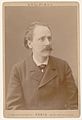 Photograph credit: Eugène Pirou; restored by Adam CuerdenJules Massenet (12 May 1842 – 13 August 1912) was a French composer of the Romantic era, best known for his operas. Between 1867 and his death, he wrote more than forty stage works in a wide variety of styles, from opéra comique to grand depictions of classical myths, romantic comedies and lyric dramas, as well as oratorios, cantatas and ballets. Massenet had a good sense of the theatre and of what would succeed with the Parisian public. Despite some miscalculations, he produced a series of successes that made him the leading opera composer in France in the late 19th and early 20th centuries. By the time of his death, he was regarded as old-fashioned; his works, however, began to be favourably reassessed during the mid-20th century, and many have since been staged and recorded. This photograph of Massenet was taken by French photographer Eugène Pirou in 1875.
 -
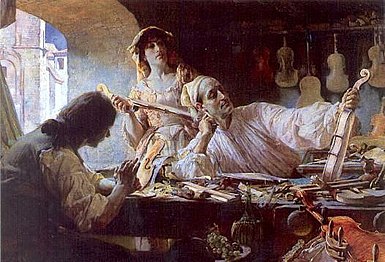 Stradivarius is one of the violins, violas, cellos and other string instruments built by members of the Italian Stradivari family, particularly Antonio Stradivari.
 -

A picture of the first theatre drawn shortly before it burned down in 1808.
The Royal Opera House is an opera house and major performing arts venue in the London district of Covent Garden. The large building, often referred to as simply "Covent Garden", is the home of The Royal Opera, The Royal Ballet and the Orchestra of the Royal Opera House. -
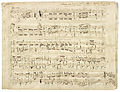 Sheet music for the Polonaise in A-flat major, Op. 53, a solo piano piece written by Frédéric Chopin in 1842. This work is one of Chopin's most admired compositions and has long been a favorite of the classical piano repertoire. The piece, which is very difficult, requires exceptional pianistic skills and great virtuosity to be interpreted. A typical performance of the polonaise lasts seven minutes.
 -
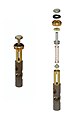 Photo: Guillaume PiolleThe anatomy of a Périnet piston valve, this one taken from a B♭ trumpet. When depressed, the valve diverts the air stream through additional tubing, thus lengthening the instrument and lowering the harmonic series on which the instrument is vibrating (i.e., it lowers the pitch). Trumpets generally use three valves, with some variations, such as a piccolo trumpet, having four. When used singly or in combination, the valves make the instrument fully chromatic, or capable of playing all twelve pitches of classical music. Trumpets may also use rotary valves instead.
 -
 The Teatro alla Scala (or La Scala, as it is known), in Milan, Italy, is one of the world's most famous opera houses. The theatre was inaugurated on 3 August 1778, under the name Nuovo Regio Ducal Teatro alla Scala with Salieri's Europa riconosciuta.
 -
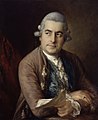 Painting: Thomas GainsboroughJohann Christian Bach (5 September 1735 – 1 January 1782) was a composer of the Classical era, the eighteenth child of Johann Sebastian Bach, and the youngest of his eleven sons. Bach was taught by his father and then, after the latter's death, by his half-brother C. P. E. Bach. Bach moved to Italy in 1754, and then to London in 1762, where he became known as the "London Bach". Bach's compositions include eleven operas, as well as chamber music, orchestral music and compositions for keyboard music. In 1764 Bach met Wolfgang Amadeus Mozart, who was eight at the time, and spent five months teaching him composition. He had considerable influence on Mozart, and was later described by scholars as his "only, true teacher".
This portrait of Bach was painted in 1776 by Thomas Gainsborough, as part of a collection started by Bach's former teacher Padre Martini. It now hangs in the National Portrait Gallery, London. -
 Photograph credit: William P. Gottlieb; restored by Adam CuerdenBilly Strayhorn (November 29, 1915 – May 31, 1967) was an American jazz composer, pianist, lyricist, and arranger, best remembered for his long-time collaboration with bandleader and composer Duke Ellington that lasted nearly three decades. Though classical music was Strayhorn's first love, his ambition to become a classical composer went unrealized because of the harsh reality of a black man trying to make his way in the world of classical music, which at that time was almost completely white. He was introduced to the music of pianists like Art Tatum and Teddy Wilson at age 19, and the artistic influence of these musicians guided him into the realm of jazz, where he remained for the rest of his life. This photograph of Strayhorn was taken by William P. Gottlieb in the 1940s.
 -
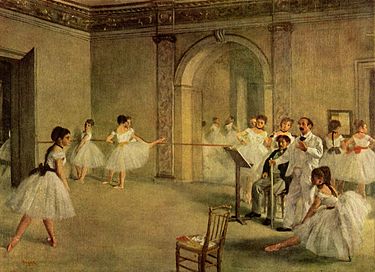 Ballet is a formalized form of dance with its origins in the French court, further developed in France and Russia as a concert dance form.
 -
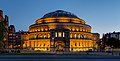 Photograph: David IliffThe Royal Albert Hall is a concert hall, seating a maximum of 5,272, on the northern edge of South Kensington, London. Constructed beginning in 1867, the hall was inaugurated on 29 March 1871. Since 1941 it has held The Proms, an eight-week summer season of daily orchestral classical music concerts and other events.


Topics
Things you can do
 |
Here are some tasks awaiting attention:
|
Categories

Associated Wikimedia
The following Wikimedia Foundation sister projects provide more on this subject:
-
 Commons
Free media repository -
 Wikibooks
Free textbooks and manuals -
 Wikidata
Free knowledge base -
 Wikinews
Free-content news -
 Wikiquote
Collection of quotations -
 Wikisource
Free-content library -
 Wikiversity
Free learning tools -
 Wiktionary
Dictionary and thesaurus


