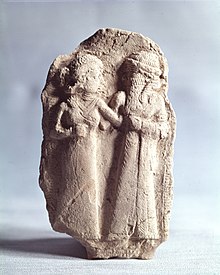
In Inanna's Descent into the Underworld, Inanna perceives that Dumuzid has failed to properly mourn her death and, when she returns from the Underworld, allows the galla demons to drag him down to the Underworld as her replacement. Inanna later regrets this decision and decrees that Dumuzid will spend half of the year in the Underworld, but the other half of the year with her, while his sister Geshtinanna stays in the Underworld in his place, thus resulting in the cycle of the seasons. In the Sumerian poem Inanna Prefers the Farmer, Dumuzid competes against the farmer Enkimdu for Inanna's hand in marriage. (Full article...)
...that the oldest laws were written in Iraq by the Sumerian King Ur-Nammu.
...that Iraq is second only to Saudi Arabia in oil reserves.
...that the national soccer team of Iraq won the AFC Asian Cup in 2007.
...the wheel was invented in the southern Iraqi city of Ur.
...that Iraq is the largest producer of dates with more than 400 types and more than 22 million date palms.
...that Iraq’s national dish is Masgouf (impaled fish) and its national cookie is Kleicha (meaning circle or wheel), both of which can be traced back to antiquity.
...in the 1940s and 1950s, Iraq had 4/5 of the world's Arecaceae population, these numbers have drastically decreased in the last few decades.
Rifat Chadirji (Arabic: رفعة الجادرجي, romanized: Rifa'ah al-Jādarjī, also RomanizedRifa'at Al Chaderchi; 6 December 1926 – 10 April 2020) was an Iraqi Turkmen architect. He was often referred to as the father of modern Iraqi architecture, having designed more than 100 buildings across the nation. (Full article...)
Image 10Masghouf fish, one of Iraq's national dishes, a Mesopotamian cuisine dating back to ancient times, typically fish caught from the rivers of Euphrates and Tigris, and grilled near the river bed (from Culture of Iraq)
Image 12Al-Mutanabi, regarded as one of the greatest, most prominent and influential poets in the Arabic language; much of his work has been translated into over 20 languages worldwide. (from Culture of Iraq)
Image 13British ruled Mesopotamia in pink (from History of Iraq)
Image 14Zaha Hadid was an Iraqi architect, artist and designer, recognised as a major figure in architecture of the late 20th and early 21st centuries. She is known for being influenced by Sumerian ancient cities. (from Culture of Iraq)
Image 20Ilham Madfai, "The Baghdad Beatle". Madfai's synthesis of Western guitar stylings with traditional Iraqi music has made him a popular performer in his native country and throughout the Middle East. (from Music of Iraq)
Image 22Kadim Al Sahir known as "TheCaesar" of Arabic songs. Considered as one of the most successful singers in the history of the Arab World. (from Music of Iraq)
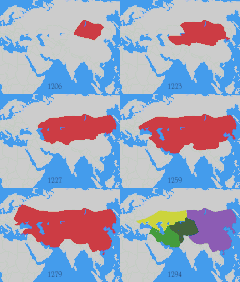
Image 23The Mongol Empire's expansion (from History of Iraq)
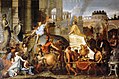
Image 27"Entry of Alexander into Babylon", a 1665 painting by Charles LeBrun, depicts Alexander the Great's uncontested entry into the city of Babylon, envisioned with pre-existing Hellenistic architecture. (from History of Iraq)
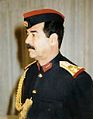
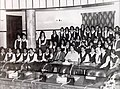
Image 28Saddam Hussein promoting women's education in the 1970s (from History of Iraq)
Image 30Nazem Ghazali was one of the most popular singers in the history of Iraq and in the Arab world. His songs are still heard by many in the Arab world. He was known by his maqam songs. (from Music of Iraq)
Image 31Al-Azzawi fighting for his seventh world heavyweight kickboxing title in his hometown of Baghdad, Iraq. (from Sport in Iraq)
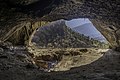
Image 33Inside the Shanidar Cave where the remains of eight adults and two infant Neanderthals, dating from around 65,000–35,000 years ago were found. (from History of Iraq)