Portal:Scotland
-

 Loch Lubnaig seen from the path to Ben Ledi.
 -
 Looking southwest from Ben_Lawers.
 -

-
 The Culloden Viaduct near to Culloden battlefield.
 -
 Loch Leven near Glencoe village.


Introduction
 |

|
|
| ||
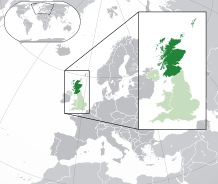
Scotland (Scots: Scotland; Scottish Gaelic: Alba) is a country that is part of the United Kingdom. It contains nearly one-third of the United Kingdom's land area, consisting of the northern part of the island of Great Britain and more than 790 adjacent islands, principally in the archipelagos of the Hebrides and the Northern Isles. To the south-east, Scotland has its only land border, which is 96 miles (154 km) long and shared with England; the country is surrounded by the Atlantic Ocean to the north and west, the North Sea to the north-east and east, and the Irish Sea to the south. The population in 2022 was 5,439,842. Edinburgh is the capital and Glasgow is the most populous of the cities of Scotland.
The Kingdom of Scotland emerged as an independent sovereign state in the 9th century. In 1603, James VI succeeded to the thrones of England and Ireland, forming a personal union of the three kingdoms. On 1 May 1707, Scotland and England combined to create the new Kingdom of Great Britain, with the Parliament of Scotland subsumed into the Parliament of Great Britain. In 1999, a Scottish Parliament was re-established, and has devolved authority over many areas of domestic policy. The country has its own distinct legal system, education system and religious history, which have all contributed to the continuation of Scottish culture and national identity. Scottish English and Scots are the most widely spoken languages in the country, existing on a dialect continuum with each other. Scottish Gaelic speakers can be found all over Scotland, however the language is largely spoken natively by communities within the Hebrides. The number of Gaelic speakers numbers less than 2% of the total population, though state-sponsored revitalisation attempts have led to a growing community of second language speakers.
The mainland of Scotland is broadly divided into three regions: the Highlands, a mountainous region in the north and north-west; the Lowlands, a flatter plain across the centre of the country; and the Southern Uplands, a hilly region along the southern border. The Highlands are the most mountainous region of the British Isles and contain its highest peak, Ben Nevis, at 4,413 feet (1,345 m). The region also contains many lakes, called lochs; the term is also applied to the many saltwater inlets along the country's deeply indented western coastline. The geography of the many islands is varied. Some, such as Mull and Skye, are noted for their mountainous terrain, while the likes of Tiree and Coll are much flatter. (Full article...)
Selected article

The production of renewable energy in Scotland is a topic that came to the fore in technical, economic, and political terms during the opening years of the 21st century. The natural resource base for renewable energy is high by European, and even global standards, with the most important potential sources being wind, wave, and tide. Renewables generate almost all of Scotland's electricity, mostly from the country's wind power.
In 2020, Scotland had 12 gigawatts (GW) of renewable electricity capacity, which produced about a quarter of total UK renewable generation. In decreasing order of capacity, Scotland's renewable generation comes from onshore wind, hydropower, offshore wind, solar PV and biomass. Scotland exports much of this electricity. On 26 January 2024, the Scottish Government confirmed that Scotland generated the equivalent of 113% of Scotland's electricity consumption from renewable energy sources, making it the highest percentage figure ever recorded for renewable energy production in Scotland. It was hailed as "a significant milestone in Scotland's journey to net zero" by the Cabinet Secretary for Wellbeing Economy, Fair Work and Energy, Neil Gray. It becomes the first time that Scotland produced more renewable energy than it actually consumed, and demonstrates the "enormous potential of Scotland's green economy" as claimed by Gray.
Continuing improvements in engineering and economics are enabling more of the renewable resources to be used. Fears regarding fuel poverty and climate change have driven the subject high up the political agenda. In 2020 a quarter of total energy consumption, including heat and transportation, was met from renewables, and the Scottish government target is half by 2030. Although the finances of some projects remain speculative or dependent on market incentives, there has been a significant—and, in all likelihood, long-term—change in the underpinning economics. (Full article...) Read more ...
Selected quotes
" ... All I've got against golf is that it takes you so far from the clubhouse ... "
" ... I have always found that the man whose second thoughts are good is worth watching ... "
In the news

No recent news
Selected biography
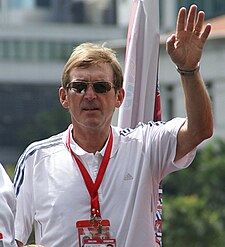
Sir Kenneth Mathieson Dalglish MBE (born 4 March 1951) is a Scottish former football player and manager. He is regarded as one of the greatest players of all time as well as one of Celtic's, Liverpool's and Britain's greatest ever players. During his career, he made 338 appearances for Celtic and 515 for Liverpool, playing as a forward, and earned a record 102 caps for the Scotland national team, scoring 30 goals, also a joint record. Dalglish won the Ballon d'Or Silver Award in 1983, the PFA Players' Player of the Year in 1983, and the FWA Footballer of the Year in 1979 and 1983. In 2009, FourFourTwo magazine named Dalglish the greatest striker in post-war British football, and he has been inducted into both the Scottish and English Football Halls of Fame. He is very highly regarded by Liverpool fans, who still affectionately refer to him as King Kenny, and in 2006 voted him top of the fans' poll "100 Players Who Shook the Kop".
Sir Kenneth began his career with Celtic in 1971, going on to win four Scottish league championships, four Scottish Cups and one Scottish League Cup with the club. In 1977, Liverpool manager Bob Paisley paid a British transfer record of £440,000 to take Dalglish to Liverpool. His years at Liverpool were among the club's most successful periods, as he won six English league championships, the FA Cup, four League Cups, five FA Charity Shields, three European Cups and one European Super Cup. In international football, Dalglish made 102 appearances and scored 30 goals for Scotland between 1971 and 1986, becoming their most capped player and joint-leading goal scorer (with Denis Law). He was chosen for Scotland's FIFA World Cup squads in 1974, 1978, 1982 and 1986, playing in all of those tournaments except the latter, due to injury.
Selected picture

Fair Isle (from Old Norse Frjóey) (Scottish Gaelic: Eileann nan Geansaidh) is an island off Scotland, lying around halfway between Shetland and the Orkney Islands. The most remote inhabited island in the United Kingdom, it is famous for its bird observatory and a traditional style of knitting.
Photo credit: Dave Wheeler
Did You Know...

- ... that after the Battle of Winwick in 1648 some Scottish prisoners were sold as slaves?
- ... that the Scottish Register of Tartans has registered district tartans for Australia as a whole, and also a state district tartan for each of Australia's six states?
- ... that East Suffolk Park, a former student hostel in Edinburgh, was once an internment camp for enemy aliens?
- ... that the Scottish surgeon John Blair was the only dux of his high school to receive his gold medal in the presence of his wife and child?
- ... that Scottish inventor and music teacher Anne Gunn was granted the first British patent for a board game in 1801?
- ... that buddleia grows from the exterior of the Church Street School swimming pool in Glasgow?
- ... that historically, lichens like Umbilicaria torrefacta have been used to naturally dye traditional Scottish tartans and textiles?
- ... that the construction of the Jubilee Bridge was featured in the 1982 documentary about the A9 road reconstruction?
Get involved


For editor resources and to collaborate with other editors on improving Wikipedia's Scotland-related articles, see WikiProject Scotland.
To get involved in helping to improve Wikipedia's Scotland related content, please consider doing some of the following tasks or joining one or more of the associated Wikiprojects:
- Visit the Scottish Wikipedians' notice board and help to write new Scotland-related articles, and expand and improve existing ones.
- Visit Wikipedia:WikiProject Scotland/Assessment, and help out by assessing unrated Scottish articles.
- Add the Project Banner to Scottish articles around Wikipedia.
- Participate in WikiProject Scotland's Peer Review, including responding to PR requests and nominating Scottish articles.
- Help nominate and select new content for the Scotland portal.
Do you have a question about The Scotland Portal that you can't find the answer to?
Post a question on the Talk Page or consider asking it at the Wikipedia reference desk.
Related portals


Other language versions
Associated Wikimedia
The following Wikimedia Foundation sister projects provide more on this subject:
-
 Commons
Free media repository -
 Wikibooks
Free textbooks and manuals -
 Wikidata
Free knowledge base -
 Wikinews
Free-content news -
 Wikiquote
Collection of quotations -
 Wikisource
Free-content library -
 Wikispecies
Directory of species -
 Wikiversity
Free learning tools -
 Wikivoyage
Free travel guide -
 Wiktionary
Dictionary and thesaurus


