Portal:Spaceflight
Wikimedia portal
|
The Spaceflight Portal
|
|
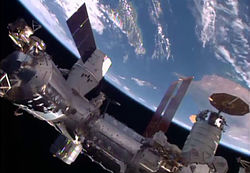
Space Exploration Technologies Corp., commonly referred to as SpaceX, is an American space technology company headquartered at the Starbase development site near Brownsville, Texas. Since its founding in 2002, the company has made numerous advancements in rocket propulsion, reusable launch vehicle, human spaceflight and satellite constellation technology. As of 2024[update], SpaceX is the world's dominant space launch provider, its launch cadence eclipsing all others, including private competitors and national programs like the Chinese space program. SpaceX, NASA, and the United States Armed Forces work closely together by means of governmental contracts.
SpaceX was founded by Elon Musk in 2002 with a vision of decreasing the costs of space launches, paving the way to a sustainable colony on Mars. In 2008, when SpaceX was almost bankrupt, Falcon 1 successfully launched into orbit after three failed launch attempts. The company then pivoted towards the development of the larger Falcon 9 rocket and the Dragon 1 capsule to satisfy NASA's COTS contracts for deliveries to the International Space Station. By 2012, SpaceX finished all COTS test flights and began delivering Commercial Resupply Services missions to the International Space Station. Also around that time, SpaceX started developing hardware to make the Falcon 9 first stage reusable. The company demonstrated the first successful first-stage landing in 2015 and re-launch of the first stage in 2017. Falcon Heavy, built from three Falcon 9 boosters, first flew in 2018 after a more than decade-long development process. As of October 2024, the company's Falcon 9 rockets have landed and flown again more than 330 times, reaching 1–2 launches a week.
John Watts Young (September 24, 1930 – January 5, 2018) was an American astronaut, naval officer and aviator, test pilot, and aeronautical engineer. He became the ninth person to walk on the Moon as Commander of the Apollo 16 mission in 1972. Young enjoyed the longest career of any astronaut, becoming the first person to fly six space missions over the course of 42 years of active NASA service. He is the only person to have piloted and commanded four different classes of spacecraft: Gemini, the Apollo command and service module, the Apollo Lunar Module, and the Space Shuttle.
Before becoming an astronaut, Young received his Bachelor of Science degree with highest honors in Aeronautical Engineering from the Georgia Institute of Technology and joined the U.S. Navy. After serving at sea during the Korean War he became a naval aviator, and graduated from the U.S. Naval Test Pilot School (Class 23), setting several world time-to-climb records as a test pilot. Young left the Navy in 1976 with the rank of captain.
In 1965 Young flew on the first crewed Gemini mission, and then commanded the 1966 Gemini 10 mission. In 1969 during Apollo 10, he became the first person to fly solo around the Moon. He then walked on the Moon and drove the Lunar Roving Vehicle on the Moon's surface during Apollo 16, and is one of only three people to have flown to the Moon twice.
Young also commanded two flights of Space Shuttle Columbia: STS-1 in 1981, the Space Shuttle program's first launch, and STS-9 in 1983. Young served as Chief of the Astronaut Office from 1974 to 1987, and retired from NASA in 2004.
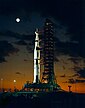
...that the Saturn V rocket (pictured) was 365 feet (111 metres) tall?

|
Here are some tasks awaiting attention:
|
 Category puzzle Category puzzle
Select [►] to view subcategories
|
|
|
|