Double genocide theory

The double genocide theory (Lithuanian: Dvigubo genocido požiūris, lit. 'Double genocide approach') is a theory said to have emerged in Lithuania after the Soviet Union ended in December 1991.[2] Formerly Soviet-occupied countries built monuments and museums to show the world the evidence of their suffering under Soviet totalitarianism.[2]
Despite the efforts being normal for national memory preservation, it has been a subject of controversy among scholars worldwide.[2] This leads to the reverse usage of double genocide theory as a negative word for what is allegedly historical revisionism.[2]
Overview
The double genocide theory holds that two equally serious genocides happened in World War II (WWII), with the Holocaust committed by Nazi Germany against Jews[3][4] and the other genocide committed by the Soviet Union against Eastern Europeans, including the Poles, Ukrainians, and Baltic states' population.[2]

Background
Supporters of the double genocide theory base their views on a series of events that involved Soviet Union's actions in their countries, which are outlined as follows.
Soviet persecution of Poles

Following the invasion of Poland, Poland was divided between Nazi Germany and the Soviet Union.[6][7] Nazi Germany occupied western Poland, while the Soviet Union occupied eastern Poland until late June 1941 when the Nazi-led Axis powers invaded the Soviet Union.[6][7] By the time, the Soviet Union had already arrested 500,000 Poles in the Kresy macroregion.[8] At least 150,000 Poles were killed by the Soviets on Polish soil throughout WWII.[8]
Soviet-occupied Poland (1939‒41)
The Soviet Union occupied 52.1% of pre-war Poland (c. 200,000 km2), with over 13,700,000 citizens.[9] Among citizens who were ethnic minorities, 37% were Ukrainians, 14.5% Belarusians, 8.4% Jews, 0.9% Russians and 0.6% Germans.[9] Joseph Stalin's occupation of eastern Poland is said to be motivated by his baseless perception that pre-war Poland was a "crime against revolution [...] counter-revolutionary activity".[10]
Katyn massacre
On March 5, 1940, Lavrentiy Beria asked Joseph Stalin in a memo to order the execution of 25,700 Polish "nationalists and counterrevolutionaries" in the Soviet-occupied zone.[11] Six members of the Soviet Politburo – Stalin, Vyacheslav Molotov, Lazar Kaganovich, Kliment Voroshilov, Anastas Mikoyan, and Mikhail Kalinin – signed an order to carry out the execution.[11] German-American historian Gerhard Weinberg said that the Soviets decided to kill the captured Poles because they considered the Poles the "avowed enemies of Soviet authority".[12] Weinberg further noted:[12]
Stalin could be certain that any revived Poland would be unfriendly [. ...] depriving it of a large proportion of its military and technical elite would make it weaker.

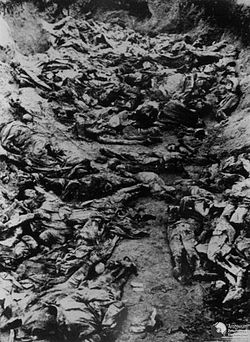
Between April and May 1940, around 22,000 Poles were executed by the Soviets in the Katyn forest (now in Smolensk, Russia).[13][14] The victims were mainly captured Polish soldiers, police and members of the intelligentsia.[13][14] They were executed as part of the Soviet campaign to erase Poland's culture and identity.[13][14] Before that, 111,091 persons associated with Poland had already been killed by the Soviets during the Stalinist purges between August 25, 1937 and November 15, 1938.[15]

Between February 10, 1940 and June 1941, as many as 1,200,000 Poles were deported to mainland Russia.[16] The deportation happened while Polish and Jewish property across the occupied zone were taken away by the Soviets.[17] Polish Jews made up 30% of the Poles deported to Siberia,[18][19] making them statistically the most targeted group among the deportees.[18][19]
Destruction of Polish society
In both the Nazi- and Soviet-occupied zone, the oppression of Poles was motivated by anti-Polish racism[7][20] (also called anti-Polonism[21] or Polonophobia[22]), which predated the Soviet Union.[20][23] In the Soviet-occupied zone, Russian culture was also imposed on the Poles by reorganizing Polish universities in line with the Statute Books for Soviet Higher Schools, and prioritizing Russian studies while suppressing Polish studies.[9] Traces of Polish history were systematically erased by the Soviets.[9] All Polish parties and organizations were dissolved,[9] while the Polish currency was made invalid,[9] causing the whole population to lose their life savings overnight.[24]
NKVD prisoner massacres
Before Nazi Germany invaded the Soviet Union in June 1941, the Soviets were holding hundreds of thousands of political prisoners in NKVD prisons across its occupied Eastern European territories.[25] Right after the invasion began, the NKVD was ordered to kill or evacuate 140,000 prisoners from Soviet-occupied eastern Poland.[25]
The order was carried out hastily.[25] Two-thirds of the said prisoners were killed by the NKVD.[25] Among the prisoners killed by the NKVD, at least 9,800 were reportedly executed in prisons and 1,443 executed during evacuation.[25] Geographically, 20,000–30,000 of them died in Soviet-occupied eastern Poland, and 9,000 in the Ukrainian SSR,[25] which had just gone through the Holodomor[26][27] and Great Purge-related massacres in the 1930s.[28][29] They were targeted for mass murder over their Polish or Ukrainian identity.[25][29]
Historian Yury Boshyk wrote:[28]
It was not only the numbers of the executed, but also the manner in which they died that shocked the populace. When the families of the arrested rushed to the prisons after the Soviet evacuation, they were aghast to find bodies so badly mutilated that many could not be identified. It was evident that many of the prisoners had also been tortured before death; others were killed en masse.
Formation of Soviet puppet state in Poland
After Nazi Germany was defeated, the Soviet Union set up a puppet state in Poland,[30] subjecting Poland to communist totalitarianism until 1989,[31][32] while Soviet troops did not leave Poland until 1993.[33] The puppet state's founding came with the arrest of 25,000 Polish Home Army soldiers,[34] who were deported to Gulags in mainland Russia.[34] As many as 100,000 Polish women were also raped by Soviet soldiers right after the war.[35]
Polish resistance
Some anti-communist Poles took up arms against the Soviets.[36] However, the armed resistance failed due to the lack of foreign support.[36] Tens of thousands of them were deported to mainland Russia,[36] with a few to no confirmed survivors.[36] Among them consisted of 6,000 Poles who had been jailed in Borowicze (now Borovichi, Russia) and 6,300 in Stalinogorsk (now Novomoskovsk, Russia).[36] The exact number is unknown as nobody has access to all of the Soviet documents.[36] Most Polish deportees were jailed in Gulags in Workutstroj,[37] Pieczorłag and Uchtiżemłag, located in the Komi Autonomous Soviet Socialist Republic in northwestern Russia.[36]
Throughout the Cold War, the Poles resisted the Soviet puppet regime peacefully. Instances of peaceful Polish resistance included the June 1956 Poznań protests (c. 100 killed and 600 wounded),[38] March 1968 protests,[32] December 1970 protests (44 killed, 1,000+ wounded and 3,000+ arrested),[39] June 1976 protests,[40] 1971 Łódź strikes,[41] 1980 Lublin strikes,[42] 1981 warning strike,[43] 1981 Polish hunger demonstrations,[44] 1982 demonstrations in Poland[45] and 1988 Polish strikes,[46] which contributed to the fall of the puppet regime in 1989.[46]
Soviet persecution of Baltic states' population
It is notable that the Baltic states also suffered under both the Nazis and Soviets.[47] Under Nazi occupation, Estonia lost 25% of her pre-war Jewish population,[48] Latvia lost 75% of her pre-war Jewish population,[49] and Lithuania lost over 95% of her Jewish population.[50][51]
1940–41
The Soviets first occupied the Baltic states between June 1940 and June 1941,[52] during which at least 124,467 were deported to mainland Russia,[52] including modern Latvia's founder Kārlis Ulmanis (1877 – 1942) who died of dysentery in a Gulag in Soviet Turkmenistan.[53] Baltic states' soldiers who refused integration into the Red Army were shot.[54][55] More were arrested and deported by the NKVD.[54][55] The year was seen by Estonians and Latvians as the "year of horror".[54][55]
1941–44
Due to the oppressive Soviet actions, many Estonians, Latvians and Lithuanians,[54][55] who were not aware of the Holocaust, accepted the Nazi takeover as the only alternative.[54][55] In Nazi-occupied Latvia, 160,000 were conscripted to fight for Hitler by July 1944.[54][56] In Nazi-occupied Lithuania, at least 20,000 were conscripted.[56][57]
Nazi occupiers who conscripted them dodged the Hague Convention by listing the conscripts as "volunteers" to make them look like Nazi fans in the eyes of foreign observers,[55] including pro-Soviet Western scholars who are influential in academia and history writing.[58][59] Despite general Western academic silence, historian Robert Conquest classified the selective deportations as a policy of "decapitation" by killing off their elites, "as was later evidently to be the motive for the Katyn massacre [in which about 22,000 Poles were killed]".[60]
1944–91
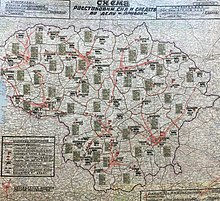
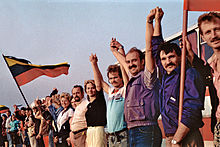
Following Soviet reconquest, resistance happened across the Baltic states from 1944 to 1956 in response to Soviet ethnic cleansing and totalitarianism.[61][62] When the Soviets cracked down on them, at least 505,000 Baltic states' residents (124,000 from Estonia, 136,000 from Latvia and 245,000 from Lithuania) were deported to Gulags in mainland Russia.[47] The Baltic states lost 20% of their total population as a result,[47] including 250,000 who fled to Western countries.[47]
In addition to mass deportations, the Soviets also scared locals into obeying them by dumping some of the insurgents' bodies at villages.[63] On October 15, 1956, Adolfas Ramanauskas ("Vanagas"), chief commander of the Union of Lithuanian Freedom Fighters,[63] released a report to highlight the tortures some of them had suffered:[63][64]
The right eye is covered with haematoma, on the eyelid there are six stab wounds made, judging by their diameter, by a thin wire or nail going deep into the eyeball. Multiple haematomas in the area of the stomach, a cut wound on a finger of the right hand. The genitalia reveal the following: a large tear wound on the right side of the scrotum and a wound on the left side, both testicles and spermatic ducts are missing.
Colonization during Cold War
The Soviet regime imported millions of colonizers from other parts of the Soviet Union,[65] changing Baltic states' ethnic composition forever.[65]
| Ethnic breakdown | 1939 | 1970 | 1989 |
|---|---|---|---|
| Estonians in Estonia | 88%[65] | 60%[65] | 61.5%[66] |
| Latvians in Latvia | 75%[65] | 57%[65] | 50.7%[65] |
| Lithuanians in Lithuania | 85%[67] | 84.6%[67] | 80.6%[67] |
Contrary to common Russian and Western leftist claims, the occupied Baltic states were exploited subjects rather than beneficiaries from the decades-long Soviet colonization.[68] Declassified archives showed that much more money was taken from the occupied Baltic states than ever invested back,[68] including huge Soviet spending on military infrastructure to oppress the native population.[68] The myth of "generous Soviet aid in developing the Baltics" is false propaganda invented for justifying Soviet colonization under which the Baltic states went through decades of oppressive rule.[68]


Deportations of Chechens and Ingush

After the Soviets reconquered Chechnya, the Chechens and Ingush were mass-deported from the Northern Caucasus as they were falsely accused of collaborating with the Nazis.[69] As many as 400,000 Chechens and 91,250 Ingush were expelled from the area within 8 days.[69]
Due to the area's mountainous terrain that favors guerrilla war, the Soviets entrapped the Chechens and Ingush by inviting them to join the Red Army Day celebrations on February 23, 1944.[69] Once they showed up, they were arrested by soldiers armed with machine guns.[69] The Chechen and Ingush deportees were sent to camps across Central Asia and Siberia.[69] They were not allowed to return to Chechnya until 1957.[69]
The Chechens and Ingush lost as much as 33% of their total pre-war population,[70] the same % loss as that of the Cambodian genocide (1975‒79) under the pro-Soviet Khmer Rouge.[71] Despite general Western academic silence, the deportations were seen by some scholars as a genocide.[69]
Debates
Issue I: double genocide theory
Dovid Katz
American Yiddish scholar Dovid Katz saw the double genocide theory as a form of Holocaust revisionism, allegedly caused by a "recent initiative that seeks to create a moral equivalence between Soviet atrocities committed against the Baltic region and the Holocaust in European history".[72]
Dovilė Budrytė
In a 2016 paper, Lithuanian-American political scientist Dovilė Budrytė said that the reason for the popular use of genocide by Ukrainians and Baltic states' people to classify Soviet crimes is that it serves as a form of "nation-building myths rooted in traumas",[73] citing studies done by other scholars.[74] She saw those views as "postcolonial trauma narratives",[73] warning against any "unquestioning acceptance".[73]
Based on her 2016 paper, Budrytė claimed in a 2023 paper that Baltic states' strong support for Ukraine's fight against the Russian invasion came from "vicarious identification with Ukraine" in relation to their shared history of having suffered "genocides" under Soviet rule.[75]
She also said that it was important to go beyond the "West" and "non-West" dichotomy in terms of lived experiences,[75] while highlighting the need of considering "power structures, broader political contexts and existing local and international norms" in order to know how valid certain claims are.[75]
James Kirchick
In a book review of Timothy Snyder's Bloodlands: Europe Between Hitler and Stalin, American reporter James Kirchick said that the Holodomor was not popularly remembered among Western intellectuals due to "the machinations of that [Soviet] regime in crafting the internationally agreed-upon legal definition of the term [genocide]".[76]
In the early drafts of the United Nations Convention on the Prevention and Punishment of the Crime of Genocide, the Soviets reportedly managed to lobby against including "social" and "political" group in the definition to prevent themselves from being held liable for their mass murders.[76] The victims belonged to several ethnic groups randomly labelled as "reactionary" or "counterrevolutionary", who were killed until Stalin chose to stop.[76]
Defending Snyder against allegations of "minimizing the Holocaust", Kirchick said that Snyder documented Nazi and Soviet atrocities equally.[76] He also noted that Stalin enabled Hitler's war in Europe in the following ways:
- Soviet communism's absolutist and totalitarian nature allowed Hitler to justify the militarization of German society to confront the Soviet Union
- Stalin told the German communists to treat the Social Democratic Party as "social fascists", dividing the German left that could have prevented the Nazis from taking over
- Stalin's signing of the Molotov-Ribbentrop pact, followed by the invasion and partition of Poland that lasted until June 1941 when Hitler invaded the Soviet Union
Michael Shafir
Romanian-Israeli political scientist Michael Shafir also shared the view of Dovid Katz,[77] calling the theory "competitive martyrdom component of Double Genocide".[77]
Kristen Ghodsee
American ethnographer Kristen Ghodsee, who previously claimed that "East German women had better sex under communism",[78] pushed the belief that the double genocide theory was somehow promoted by "economic and political elites" due to "fears of a leftist resurgence in the face of [...] extreme social inequalities [... and] the excesses of neoliberal capitalism".[79] She accused the "elites" of "focusing almost exclusively on Joseph Stalin's crimes" in debates about communism and "linking all leftist ideals to the excesses of Stalinism".[79]
Timothy Snyder
American historian Timothy Snyder published the book Bloodlands: Europe Between Hitler and Stalin in 2010, which touches the debate, but has been accused by some left-wing scholars,[80] including Dovid Katz and Efraim Zuroff,[80] of "suggesting a moral equivalence between Soviet mass murders and the Nazi Holocaust". In response, Snyder said,[81]
I coincide with Zuroff and Katz on the centrality of the Holocaust, but we must not overlook how Stalin enabled Hitler's crimes.
While accusing Snyder of trivializing the Holocaust, Zuroff himself denied the Holodomor[82][26] and Bosnian genocide,[83] despite the International Court of Justice (ICJ) and the International Criminal Tribunal for the former Yugoslavia (ICTY) having ruled that the Bosnian genocide was indeed a genocide.[84][85]
In addition, scholars who hold similar views to Zuroff often accuse the NATO of "inventing" the Bosnian genocide to justify the bombing and "destruction" of Yugoslavia,[84][85] or blame the Bosnian genocide victims for their own suffering.[84][85] The leading Bosnian genocide deniers include but not limited to Michael Parenti, Edward S. Herman, David Peterson, Jared Israel, Tariq Ali, Mick Hume and Diana Johnstone,[84][85] most of whom also reject the double genocide theory.[84][85]
Issue II: Katyn massacre
Over the past decades, it has been debated whether the Katyn massacre ‒ a major war crime committed by the Soviets[16] ‒ could be seen as a genocide in relation to the double genocide theory. Many Polish scholars, including historian Adam Basak,[16][86] jurist Cezary Mik,[16][87] Karolina Kosińska,[16][88] and prosecutor Małgorzata Kuźniar-Plota,[16][89] who investigated the massacre,[16][89] believed that the Katyn massacre qualified as a genocide.[16]
Adam Basak
Historian Adam Basak noted:[16][86]
[The Soviet Politburo's] intent was to destroy a part of the Polish national group [...] twenty-six thousand representatives of the intellectual elite, selected because of their social status and social function.
Cezary Mik
Jurist Cezary Mik called the massacre "genocidal murder of the Polish elite in Katyn and other places",[16][87] while Karolina Kosińska said:[16][88]
If we talk about a specific plan to destroy a group, we can undoubtedly point to the USSR's policy [. ...] various genocidal acts against the Polish nation, acts the most spectacular of which was the Katyn Massacre.
Małgorzata Kuźniar-Plota
More importantly, prosecutor Małgorzata Kuźniar-Plota,[16][89] who investigated the massacre,[16][89] ruled that:[16][89]
[The Katyn massacre] had all the characteristics of the crime of genocide specified in Article 2 of the Convention on the Prevention and Punishment of the Crime of Genocide.[90]
Issue III: Holodomor


Holodomor, a related event that happened in Soviet Ukraine before WWII,[26][27] is sometimes raised in debates about the double genocide theory.[26][27] The Holodomor was a man-made[26][27] famine in which around 7,000,000 people died under Stalin's policies.[26][27] As of 2025, the Holodomor is recognized by over 30 countries as a genocide:[91]
 |
Countries which officially recognize the Holodomor as genocide | |
|---|---|---|
|
| ||


Many Western scholars who reject the double genocide theory are also found to have denied the Holodomor,[92][93] mainly out of communist sympathy, which prevents them from recognizing the worth of Ukrainians as equal humans. Such denial is considered essentially racist and dehumanizing.[92][93] Jurij Dobczansky, a senior Library of Congress cataloging specialist,[94] commented on such denial:[95]
Holodomor denial [...] consists of especially vitriolic anti-Western and anti-Ukrainian tirades [...] accusations of foreign influence and Nazi sympathies, or ulterior motives.
Related pages
- Jan Grabowski
- Holocaust uniqueness debate
- Guerrilla war in the Baltic states
- Antisemitism in the Soviet Union
References
- ↑ Vidar (10 March 2022). "No more time (by TUSE in Gdansk, Poland)". Street Art Utopia.
- ↑ 2.0 2.1 2.2 2.3 2.4
- Moses, Anthony Dirk (May 2012). "The Canadian Museum for Human Rights: The 'Uniqueness of the Holocaust' and the Question of Genocide". Journal of Genocide Research. 14 (2): 215–238. doi:10.1080/14623528.2012.677762. S2CID 216139226.
- Brook, Daniel (2015-07-26). "Double Genocide". Slate. ISSN 1091-2339. Retrieved 2023-06-15.
- Budrytė, Dovilė (2018). "Memory, War, and Mnemonical In/Security: A Comparison of Lithuania and Ukraine". In Budrytė, Dovilė; Buhari-Gulmez, Didem; Resende, Erica (eds.). Crisis and Change in Post-Cold War Global Politics: Ukraine in a Comparative Perspective. Springer International Publishing. pp. 155–177. doi:10.1007/978-3-319-78589-9_7. ISBN 978-3-319-78589-9.
- ↑
- Shapiro, P.A. (2007). "Faith, murder, resurrection: The Iron Guard and the Romanian Orthodox Church". Antisemitism, Christian Ambivalence, and the Holocaust. Indiana University Press. ISBN 9780253116741. OCLC 191071016. Retrieved November 4, 2024.
- Laqueur, Walter (July 30, 2009). "Towards the Holocaust". The Changing Face of Antisemitism: From Ancient Times to the Present Day. Oxford University Press, USA. ISBN 9780195341218. Retrieved November 3, 2024.
- "Deportation of Hungarian Jews". Timeline of Events. United States Holocaust Memorial Museum. Archived from the original on 25 November 2017. Retrieved 6 October 2017.
- Brosnan, Matt (12 June 2018). "What Was The Holocaust?". Imperial War Museum. Archived from the original on 2 March 2019. Retrieved 2 March 2019.
- "36 Questions About the Holocaust". Museum of Tolerance, Los Angeles. Retrieved 2024-10-14.
- ↑
- Polonsky, Antony (1989). "Polish-Jewish relations and the Holocaust". Polin: Studies in Polish Jewry. 4: 226–242. doi:10.3828/polin.1989.4.226. Retrieved October 16, 2024.
- "Murder of the Jews of Poland". Yad Vashem. Retrieved October 16, 2024.
- "POLISH VICTIMS". Holocaust Encyclopedia. Retrieved October 16, 2024.
- Waltman, Michael; Haas, John (2010). The Communication of Hate. Peter Lang. p. 52. ISBN 978-1433104473.
- "Unter der NS-Herrschaft ermordete Juden nach Land. / Jews by country murdered under Nazi rule". Bundeszentrale für politische Bildung / Federal Agency for Civic Education (Germany). April 29, 2018.
- ↑ "Museum of the Occupation of Latvia". Latvijas Okupācijas muzejs. Retrieved March 18, 2025.
- ↑ 6.0 6.1 Telegrams sent by Friedrich Werner von der Schulenburg, German ambassador to the Soviet Union, from Moscow to the German Foreign Office: No. 317 Archived 2009-11-07 at the Wayback Machine of 10 September 1939, No. 371 Archived 2007-04-30 at the Wayback Machine of 16 September 1939, No. 372 Archived 2007-04-30 at the Wayback Machine of 17 September 1939. The Avalon Project, Yale Law School. Retrieved 14 November 2006.
- ↑ 7.0 7.1 7.2 1939 wrzesień 17, Moskwa Nota rządu sowieckiego nie przyjęta przez ambasadora Wacława Grzybowskiego (Note of the Soviet government to the Polish government on 17 September 1939, refused by Polish ambassador Wacław Grzybowski). Retrieved 15 November 2006.
- ↑ 8.0 8.1
- DAVID ENGEL, FACING A HOLOCAUST: THE POLISH GOVERNMENT-IN-EXILE AND THE JEWS, 1943–1945, at 71 (1993) (“The German broadcast [announcing the discovery of the Katyn graves] charged that these officers had been shot by the Soviets in March 1940 . . . .”).
- "In the 1939-1941 period alone, Soviet-inflicted suffering on all citizens in Poland exceeded that of Nazi-inflicted suffering on all citizens. (...) The Soviet-imposed myth about "Communist heroes of resistance" enabled them for decades to avoid the painful questions faced long ago by other Western countries." Johanna Granville, H-Net Review of Jan T. Gross. Revolution from Abroad.
- Tomasz Szarota & Wojciech Materski (2009), Polska 1939–1945. Straty osobowe i ofiary represji pod dwiema okupacjami, Warsaw: Institute of National Remembrance, ISBN 978-83-7629-067-6 (Excerpt reproduced in digital form).
- Sterio, Milena (2012). "Katyn Forest Massacre: Of Genocide, State Lies, and Secrecy". Case Western Reserve Journal of International Law. 44 (3). Retrieved March 11, 2025.
- ↑ 9.0 9.1 9.2 9.3 9.4 9.5 Trela-Mazur, Elżbieta (1998) [1997]. Włodzimierz Bonusiak; Stanisław Jan Ciesielski; Zygmunt Mańkowski; Mikołaj Iwanow (eds.). Sovietization of educational system in the eastern part of Lesser Poland under the Soviet occupation, 1939-1941 [Sowietyzacja oświaty w Małopolsce Wschodniej pod radziecką okupacją 1939-1941]. Kielce: Wyższa Szkoła Pedagogiczna im. Jana Kochanowskiego. pp. 43, 294. ISBN 83-7133-100-2.. Also in: Trela-Mazur 1997, Wrocławskie Studia Wschodnie, Wrocław.
- ↑ Władysław Anders (1995). Bez ostatniego rozdziału (in Polish). Lublin: Test. p. 540. ISBN 83-7038-168-5.
- ↑ 11.0 11.1 Brown, Archie (2009). The Rise and Fall of Communism. HarperCollins. p. 140. ISBN 978-0061138799. Archived from the original on 18 June 2013. Retrieved 7 May 2011.
- ↑ 12.0 12.1 Weinberg, Gerhard (2005). A World at Arms. Cambridge University Press. p. 107. ISBN 978-0521618267.
- ↑ 13.0 13.1 13.2 Sanford, George (2005). Katyn and the Soviet Massacre of 1940. Routledge. pp. 20–24. ISBN 0415338735.
- ↑ 14.0 14.1 14.2
- "The Katyń Massacres of 1940". SciencePo. July 23, 2011. Retrieved March 11, 2025.
- "Documents: US, UK hushed up Soviet massacre of 22,000 Poles in WWII". NBC News. September 11, 2012. Retrieved March 11, 2025.
- Brzozowska-Pasieka, Monika. "The Secret Soviet Genocide of WWII". Victims of Communism Memorial Foundation. Retrieved March 11, 2025.
- "Putin blames Poland for WWII and says Soviet occupation "saved lives"". Notes from Poland. December 23, 2019. Retrieved March 11, 2025.
- "War crimes are a common thing for the Kremlin. We recall the mass murders and genocide during World War II, for which Russia (so far) has not been punished — a story in archival photos". Бабель. April 25, 2022. Retrieved March 11, 2025.
- Cuesta, Javier G. (April 28, 2023). "Russia rewrites the history of 22,000 Poles murdered by Soviet forces during World War II". EL PAÍS English. Retrieved March 11, 2025.
- ↑ McLoughlin, Barry, and McDermott, Kevin (eds). Stalin's Terror: High Politics and Mass Repression in the Soviet Union. Palgrave Macmillan, December 2002. ISBN 1-4039-0119-8, p. 164
- ↑ 16.00 16.01 16.02 16.03 16.04 16.05 16.06 16.07 16.08 16.09 16.10 16.11 16.12 16.13
- "The first deportation of Poles to Russia". European Network Remembrance and Solidarity (ENRS). Retrieved March 11, 2025.
- Rummel, R.J. "Statistics Of Poland's Democide: Addenda". University of Hawaii System. Retrieved March 11, 2025.
- Karski, Karol (2012). "The Crime of Genocide Committed against the Poles by the USSR before and during World War II: An International Legal Study". Case Western Reserve Journal of International Law. 45 (3). Retrieved March 11, 2025.
- Ludwika, Zofia; Ptasnik, Malachowska. "A Polish Woman's Daily Struggle to Survive: Her Diary of Deportation, Forced Labor, and Death in Kazakhstan: April 13, 1940-May 26, 1941". Rice University. Retrieved March 11, 2025.
- ↑ (in Polish) Represje 1939-41 Aresztowani na Kresach Wschodnich Archived 2006-10-21 at the Wayback Machine (Repressions 1939–41. Arrested on the Eastern Borderlands.) Ośrodek Karta. Retrieved 15 November 2006.
- ↑ 18.0 18.1 Grabowski, Jan; Klein, Shira (February 9, 2023). "Wikipedia's Intentional Distortion of the History of the Holocaust". The Journal of Holocaust Research. 37 (2): 133–190. doi:10.1080/25785648.2023.2168939. Retrieved January 20, 2025.
- ↑ 19.0 19.1 Jan Tomasz Gross, Revolution from Abroad (Princeton: Princeton University Press, 2003), pp. 196–98.
- ↑ 20.0 20.1 Myron Weiner, Sharon Stanton Russell, ed. (2001). "Stalinist Forced Relocation Policies". Demography and National Security. Berghahn Books. pp. 308–315. ISBN 1-57181-339-X.
- ↑ Thaddeus C. Radzilowski, Anti-Polonism Archived 15 June 2016 at the Wayback Machine
- ↑ Ilya Prizel (13 August 1998). National Identity and Foreign Policy: Nationalism and Leadership in Poland, Russia and Ukraine. Cambridge University Press. p. 171. ISBN 978-0-521-57697-0.
- ↑ Myroslav Shkandrij, Russia and Ukraine: literature and the discourse of empire from Napoleonic to postcolonial times, McGill-Queen's Press - MQUP, 2001, 354 pages. ISBN 0-7735-2234-4 Page 69.
- ↑ Karolina Lanckorońska (2001). "I - Lwów". Wspomnienia wojenne; 22 IX 1939 - 5 IV 1945 (in Polish). Kraków: ZNAK. p. 364. ISBN 83-240-0077-1.
- ↑ 25.0 25.1 25.2 25.3 25.4 25.5 25.6
- Popiński, Krzysztof; Kokurin, Aleksandr; Gurjanow, Aleksandr (1995). Drogi śmierci. Ewakuacja więzień sowieckich z Kresów Wschodnich II Rzeczypospolitej w czerwcu i lipcu 1941 [Roads of death. Evacuation of Soviet prisons from the Eastern Borderlands of the Second Polish Republic in June and July 1941] (in Polish). Warszawa: Wydawnictwo "Karta". ISBN 83-900676-9-2.
- Mikoda, Janina, ed. (1997). Zbrodnicza ewakuacja więzień i aresztów NKWD na Kresach Wschodnich II Rzeczypospolitej w czerwcu – lipcu 1941 roku. Materiały z sesji naukowej w 55. rocznicę ewakuacji więźniów NKWD w głąb ZSRR, Łódź 10 czerwca 1996 r. [Criminal evacuation of NKVD prisons and detention centers in the Eastern Borderlands of the Second Polish Republic in June–July 1941. Materials from the scientific session on the 55th anniversary of the evacuation of NKVD prisoners deep into the USSR, Łódź, June 10, 1996] (in Polish). Warszawa: Główna Komisja Badania Zbrodni przeciwko Narodowi Polskiemu – Instytut Pamięci Narodowej. ISBN 83-903356-6-2.
- Musiał, Bogdan (2001). Rozstrzelać elementy kontrrewolucyjne. Brutalizacja wojny niemiecko-sowieckiej latem 1941 roku [Shoot the counter-revolutionary elements. The brutalization of the German-Soviet war in the summer of 1941] (in Polish). Warszawa: Stowarzyszenie Kulturalne Fronda. ISBN 83-88747-40-1.
- Berkhoff, Karel Cornelis (2004). Harvest of Despair. p. 14. ISBN 0674020782. Retrieved 2013-12-30.
- Robert Gellately. Lenin, Stalin, and Hitler: The Age of Social Catastrophe. Knopf, 2007 ISBN 1-4000-4005-1
- ↑ 26.0 26.1 26.2 26.3 26.4 26.5
- "Worldwide Recognition of the Holodomor as Genocide". Holodomor Museum. November 24, 2007. Retrieved October 30, 2024.
- Boriak (2008). Hennadii. Vol. 30. Harvard Ukrainian Research Institute. pp. 199–215. JSTOR stable/23611473. Retrieved October 30, 2024.
- Bezo, Brent; Maggi, Stefania (April 15, 2015). "Living in "survival mode:" Intergenerational transmission of trauma from the Holodomor genocide of 1932–1933 in Ukraine". Social Science & Medicine. 134. doi:10.1016/j.socscimed.2015.04.009. Retrieved October 30, 2024.
- Andriewsky, Olga (2015). "Towards a decentred history: The study of the Holodomor and Ukrainian historiography". East/West: Journal of Ukrainian Studies. 2 (1). doi:10.21226/T2301N. ISSN 2292-7956. Retrieved October 30, 2024.
- Mills, Claire; Walker, Nigel (March 3, 2023). "Ukrainian Holodomor and the war in Ukraine". House of Commons Library. Retrieved October 30, 2024.
- "Holodomor | Holocaust and Genocide Studies | College of Liberal Arts". University of Minnesota Twin Cities. Retrieved October 30, 2024.
- ↑ 27.0 27.1 27.2 27.3 27.4
- Applebaum, Anne (September 16, 2024). "Holodomor | Facts, Definition, & Death Toll". Britannica. Retrieved October 30, 2024.
Holodomor, man-made famine that convulsed the Soviet republic of Ukraine from 1932 to 1933, peaking in the late spring of 1933.
- "Holodomor (Ukrainian Genocide)". The Genocide Education Project. Retrieved October 30, 2024.
- "Common Lies about the Holodomor". Ukraïner. November 1, 2020. Retrieved October 30, 2024.
- "Why Did So Many Ukrainians Die in the Soviet Great Famine?". Kellogg Insight. October 1, 2022. Retrieved October 30, 2024.
- "Ukraine: This 96-year-old survived Soviet Holodomor famine". DW News. November 24, 2023. Retrieved October 30, 2024.
- Applebaum, Anne (September 16, 2024). "Holodomor | Facts, Definition, & Death Toll". Britannica. Retrieved October 30, 2024.
- ↑ 28.0 28.1 Richard Rhodes (2002). Masters of Death: The SS-Einsatzgruppen and the Invention of the Holocaust. New York: Alfred A. Knopf. ISBN 0-375-40900-9. Rather than releasing their prisoners as they hurriedly retreated during the first week of the war, the Soviet secret police killed most of them. In the first week of the invasion, the NKVD prisoner executions totaled some 10,000 in western Ukraine and more than 9,000 in Vinnytsia, eastward toward Kyiv. Comparable numbers of prisoners were executed in eastern Poland, Byelorussia, Lithuania, Latvia, and Estonia. The Soviet areas had already sustained hundreds of thousands of executions during the 1937–1938 Great Purge.
- ↑ 29.0 29.1 Valery Vasiliev, Yuriy Shapoval, "Stages of «Great Terror»: The Vinnytsia Tragedy", Zerkalo Nedeli, No. 31 (406), August 17–23, 2002, (in Russian Archived 2007-11-28 at the Wayback Machine, in Ukrainian Archived 2009-05-18 at the Wayback Machine)
- ↑ The Great Globe Itself: A Preface to World Affairs By William Bullitt, Francis P. Sempa
- ↑ "Fall of Communism in Eastern Europe, 1989". Office of the Historian (US Government). Retrieved March 11, 2025.
- ↑ 32.0 32.1
- Lappin, Shalom (2006), ‘How Class Disappeared from Western Politics’, Dissent, Vol. 51, No. 1, pp. 73-78.
- Nirenberg, David (2013). Anti-Judaism: The Western Tradition. Retrieved February 9, 2025.
- Tabarovsky, Izabella (2022). "Demonization Blueprints: Soviet Conspiracist Antizionism in Contemporary Left-Wing Discourse". Journal of Contemporary Antisemitism (JCA). Academic Studies Press. doi:10.26613/jca/5.1.97. Retrieved February 9, 2025.
- Troy, Gil (February 1, 2024). "How Palestine Hijacked the U.S. Civil Rights Movement". Tablet magazine. Retrieved February 9, 2025.
- Kirsch, Adam (2024), On Settler Colonialism: Ideology, Violence, and Justice, W.W. Norton and Company, New York and London.
- Lappin, Shalom (2025). "The Nazification of the Postmodernist Left". Fathom Journal. Retrieved February 9, 2025.
When Jews insisted on highlighting antisemitism [...] they were accused of reactionary particularism [. ...] much of the left resisted attempts to present the Nazi genocide as a Jewish cataclysm [. ...] It did not see the oppression of Soviet Jewry, or the desperate flight of Ethiopian Jews, as issues [. ...] Stalinist purges [...] Jews [...] as cosmopolitans and Zionist agents. In 1968-69 the Polish Communist Party conducted an anti-Zionist attack on [...] its Jewish population of 35,000, resulting in the forced emigration of approximately 25,000 of them.
- ↑
- Murphy, Dean E. (September 19, 1993). "Last Russian Troops Depart From Poland : Military: The Red Army arrived to battle Nazis 54 years ago. Its successors' exit leaves the nation free of foreign interveners for the first time since then". Los Angeles Times. Retrieved March 11, 2025.
- Kornat, Marek (September 16, 2023). "Why did Russian troops leave Poland as late as in 1993, not in 1989?". Wszystko co najważniejsze. Retrieved March 11, 2025.
- Sieradzka, Monika (September 17, 2018). "The day Soviet troops left Poland". DW News. Retrieved March 11, 2025.
- ↑ 34.0 34.1 Paczkowski, Andrzej (1999). "Enemy Nation". Black Book of Communism. Crimes, Terror, Repression. London: Harvard University Press. pp. 372‒375. Archived from the original on January 31, 2023. Retrieved March 11, 2025.
- ↑ Joanna Ostrowska, Marcin Zaremba, "Kobieca gehenna" (The women's ordeal) Archived 2019-03-23 at the Wayback Machine, Polityka - No 10 (2695), 2009-03-07; pp. 64-66. (in Polish)
Dr. Marcin Zaremba Archived 2011-10-07 at the Wayback Machine of Polish Academy of Sciences, the co-author of the article cited above – is a historian from Warsaw University Department of History Institute of 20th Century History (cited 196 times in Google scholar). Zaremba published a number of scholarly monographs, among them: Komunizm, legitymizacja, nacjonalizm (426 pages),[1] Marzec 1968 (274 pages), Dzień po dniu w raportach SB (274 pages), Immobilienwirtschaft (German, 359 pages), see inauthor:"Marcin Zaremba" in Google Books.
Joanna Ostrowska Archived 2016-03-14 at the Wayback Machine of Warsaw, Poland, is a lecturer at Departments of Gender Studies at two universities: the Jagiellonian University of Kraków, the University of Warsaw as well as, at the Polish Academy of Sciences. She is the author of scholarly works on the subject of mass rape and forced prostitution in Poland in the Second World War (i.e. "Prostytucja jako praca przymusowa w czasie II Wojny Światowej. Próba odtabuizowania zjawiska," "Wielkie przemilczanie. Prostytucja w obozach koncentracyjnych," etc.), a recipient of Socrates-Erasmus research grant from Humboldt Universitat zu Berlin, and a historian associated with Krytyka Polityczna. - ↑ 36.0 36.1 36.2 36.3 36.4 36.5 36.6 The establishment of communist regimes in Eastern Europe, 1944-1949 By Norman Naimark
- ↑ "Poles and Polish citizens in the Gulag". Gulag Online. Retrieved March 11, 2025.
- ↑ (in Polish) "Z perspektywy historyka i w świetle dokumentów…" – interview with dr Łukasz Jastrząb
- ↑ "Piotr Brzeziński z IPN: "Czarny czwartek" mógł być prowokacją wymierzoną w Gomułkę". dzieje.pl (in Polish). Archived from the original on 2 August 2021. Retrieved 2 January 2021.
- ↑ The origins of democratization in Poland By Michael H. Bernhard, page 45
- ↑ Jarska, Natalia (12 April 2011). "Bunt miasta kobiet". Tygodnik Powszechny (in Polish). Retrieved 8 February 2025.
- ↑ Warsaw Voice, Solidarity 1980-81
- ↑
- The biggest strike in history of Poland, J. Polonus Archived 2008-05-01 at the Wayback Machine
- "Bydgoszcz March". Archived from the original on 2008-12-11. Retrieved 2009-01-02.
- Kalendarium 1980–1981, Jaroslaw Szarek Archived 2011-07-18 at the Wayback Machine
- ↑
- "Anger Over Food Spreads in Poland". By James M. Markham, The New York Times
- The Polish Revolution By Timothy Garton Ash, p. 191
- "Jerzy Kropiwnicki, the president of Łódź". Archived from the original on 2008-12-22. Retrieved 2009-01-02.
- ↑
- (in Polish) Encyclopedia of Solidarity – Lubin Crime. Article written by Lukasz Kaminski, historian of Wroclaw University. Encyklopedia-solidarnosci.pl. Retrieved on August 31, 2011.
- Rzeczpospolita daily, KAZIMIERZ GROBLEWSKI "Winni sa niewinni" Archived May 3, 2009, at the Wayback Machine. Rzeczpospolita.pl (December 13, 2001). Retrieved on August 31, 2011.
- Poland under Martial Law, by Roman Stefanowski, Blinken Open Society Archives
- August 1982 demonstration, Portal of the Polish Press Agency. 11listopada1918.pl. Retrieved on August 31, 2011.
- ↑ 46.0 46.1
- Turning the tables? by Andy Zebrowski “The second massive wave of strikes this year has shaken the Polish regime to such an extent that it doesn't know which way to turn”
- Pushing back the curtain. BBC News, Poland 1984 - 1988
- Second August, by Andrzej Grajewski
- ↑ 47.0 47.1 47.2 47.3
- The Baltic States. Years of dependence 1940-1990 (Romuald J. Misiunas, Rein Taagepera, University of California Press, Berkeley and Los Angeles, 1993)
- "Soviet repression and deportations in the Baltic states". Gulag Online. Retrieved March 15, 2025.
- Narratives of Exile and Identity: Soviet Deportation Memoirs from the Baltic States (V. Davoliute, T. Balkelis, Central European Press, 2018)
- A Soviet Story: Mass Deportation, Isolation, Return (Alain Blum, Emilia Koustova in Narratives of Exile and Identity, Central European University Press, 2018)
- Soviet Mass Deportation from Latvia, briefing papers of museum of the Occupation of Latvia (Ministry of Foreign Affairs of Latvia)
- The History of the Occupation of Latvia (Museum of the Occupation of Latvia)
- ↑ "The Holocaust in Estonia – Klooga Concentration Camp and Holocaust Memorial". September 5, 2019.
- ↑ "The Names of Shoah Victims from Latvia". Yad Vashem.
- ↑ Porat, Dina (2002). "The Holocaust in Lithuania: Some Unique Aspects". In David Cesarani (ed.). The Final Solution: Origins and Implementation. Routledge. pp. 161–162. ISBN 978-0-415-15232-7.
- ↑ Reich, Aaron (23 September 2021). "On This Day: Nazis liquidate Vilnius Ghetto, slaughter Lithuanian Jews". The Jerusalem Post | JPost.com. Retrieved 2023-08-19.
- ↑ 52.0 52.1
- Dunsdorfs, Edgars. The Baltic Dilemma. Speller & Sons, New York. 1975
- The Harvest of Sorrow: Soviet Collectivization and the Terror-Famine (1986)
- Stephane Courtois; Werth, Nicolas; Panne, Jean-Louis; Paczkowski, Andrzej; Bartosek, Karel; Margolin, Jean-Louis & Kramer, Mark (1999). The Black Book of Communism: Crimes, Terror, Repression. Harvard University Press. ISBN 0-674-07608-7.
- Küng, Andres. Communism and Crimes against Humanity in the Baltic States. 1999 "Communism and Crimes against Humanity in the Baltic states". Archived from the original on 2001-03-01. Retrieved 2018-05-07.
- Buttar, Prit (May 21, 2013). Between Giants. Bloomsbury USA. ISBN 978-1-78096-163-7.
- ↑ "Kārlis Ulmanis". Britannica. August 31, 2024. Retrieved October 27, 2024.
- ↑ 54.0 54.1 54.2 54.3 54.4 54.5 Motyka G., Wnuk R., Stryjek T., Baran A., 2012. Wojna po wojnie. Antysowieckie podziemie w Europie Środkowo-Wschodniej w latach 1944-1953. Scholar, Gdańsk-Warsaw.
- ↑ 55.0 55.1 55.2 55.3 55.4 55.5 Piotrowski, Sławomir (2018). "Security policy of the Baltic states and its determining factors". Security & Defence Quarterly. 22 (5): 46‒70. Retrieved March 19, 2025.
- ↑ 56.0 56.1 Palmer A., 2008. Północne sąsiedztwo. Historia krajów i narodów Morza Bałtyckiego. Książka i Wiedza, Warsaw.
- ↑ Kasekamp A., 2013. Historia państw bałtyckich. PISM, Warsaw.
- ↑
- Pollack, Eunice G. (2013). Racializing Antisemitism: Black Militants, Jews, and Israel 1950-present (PDF). Vidal Sassoon International Center for the Study of Antisemitism, Hebrew University of Israel. p. 4.
- "Malcolm X founded Harvard University's antisemitism". Jewish News Syndicate (JNS). 22 February 2024.
Jews and Zionism have been cast as the ultimate oppressors of black Americans.
- Pierre, Dion J. (June 17, 2019). "How Anti-Semitism Became a Staple of 'Woke' Activism on Campus". National Association of Scholars (NAS). Retrieved October 27, 2024.
- "Nation of Islam". Anti-Defamation League (ADL). January 9, 2021. Retrieved October 27, 2024.
- ↑
- "The uncomfortable truth about BLM, Malcolm X and anti-Semitism". The Spectator. January 26, 2021. Retrieved October 27, 2024.
- Pollack, Eunice G. (June 1, 2022). "Black Antisemitism in America: Past and Present". The Institute for National Security Studies (INSS) (Special Publication). Retrieved October 27, 2024.
- Royden, Laura; Hersh, Eitan (April 17, 2023). "Antisemitic Attitudes among Young Black and Hispanic Americans". Journal of Race, Ethnicity, and Politics. 8 (1). Cambridge, England: Cambridge University Press. Retrieved October 27, 2024.
- Rossman-Benjamin, Tammi (June 19, 2013). "Identity Politics, the Pursuit of Social Justice, and the Rise of Campus Antisemitism: A Case Study" (PDF). AMCHA Initiative. Indiana University Press. Retrieved October 27, 2024.
- ↑ The Harvest of Sorrow: Soviet Collectivization and the Terror-Famine (1986)
- ↑ "The Brothers of the Wood. Bandits, Says Russia; Politicians, Says Prisoner's Counsel". The Sun. New York, New York. 25 June 1908. p. 9. Retrieved 13 February 2022.
- ↑ "Jan Pouren Case". The Independent. Vol. 65, no. 3120. New York. 17 September 1908. p. 673.
- ↑ 63.0 63.1 63.2 * Dundovich, E., Gori, F. and Guercett, E. Reflections on the gulag. With a documentary appendix on the Italian victims of repression in the USSR, Feltrinelli Editore IT, 2003. ISBN 88-07-99058-X
- Lučinskas, Gintaras. "12 16. Lietuvos Laisvės Armija – partizaninio karo pradininkė Dzūkijoje" (in Lithuanian). Retrieved September 28, 2019.
- "Istorinė Lietuvos laisvės armijos reikšmė pasipriešinime okupantams". www.xxiamzius.lt (in Lithuanian). Archived from the original on September 29, 2019. Retrieved September 29, 2019.
- ↑ Kuodytė, Dalia and Tracevskis, Rokas. The Unknown War: Armed Anti-Soviet Resistance in Lithuania in 1944–1953, 2004. ISBN 9986-757-59-2
- ↑ 65.0 65.1 65.2 65.3 65.4 65.5 65.6 Hiden, Johan; Salmon, Patrick (1994) [1991]. The Baltic Nations and Europe (Revised ed.). Harlow, England: Longman. ISBN 058225650X.
- ↑ "Last USSR census 30 years ago counted largest-ever number of residents". Eesti Rahvusringhääling (EER). January 28, 2019. Retrieved March 18, 2025.
- ↑ 67.0 67.1 67.2 "Statistical yearbooks of Lithuania". Statistikos Departamentas (in Lithuanian). Archived from the original on November 14, 2010. Retrieved March 18, 2025.
{cite web}: CS1 maint: bot: original URL status unknown (link) - ↑ 68.0 68.1 68.2 68.3
- Abene, Aija, ed. (2011). Damage Caused by the Soviet Union in the Baltic States (PDF).
- Krūmiņš, Gatis. "The Investments of the USSR Occupying Power in the Baltic Economies – Myths and Reality" (PDF). Vidzemes Augstskola.
- "Gatis Krūmiņš: Debunking Myths of Soviet Investment in the Baltics". Deep Baltic. 2017-06-20. Retrieved 2025-01-10.
- ↑ 69.0 69.1 69.2 69.3 69.4 69.5 69.6
- Vatchagaev, Mairbek (1970). "Remembering the 1944 Deportation: Chechnya's Holocaust". North Caucasus Weekly. 8 (8). Retrieved March 19, 2025.
- Brauer, Birgit (2002). "Chechens and the survival of their cultural identity in exile". Journal of Genocide Research. 4 (3): 387–400. doi:10.1080/14623520220151970. Retrieved December 21, 2024.
Published online: 03 Aug 2010
- Aurélie, Campana (November 5, 2007). "The Massive Deportation of the Chechen People". Science Po. Retrieved March 19, 2025.
- ↑ Dunlop, John B. (1998). Russia Confronts Chechnya: Roots of a Separatist Conflict. Cambridge: Cambridge University Press. ISBN 978-0-521-63619-3. LCCN 97051840.
- ↑
- Hinton, Alexander Laban (1998). Why Did You Kill?: The Cambodian Genocide and the Dark Side of Face and Honor. Cambrdige University Press. Retrieved December 10, 2024.
Published online by Cambridge University Press: 26 March 2010
- Hannum, Hurst (2001). "International Law and Cambodian Genocide: The Sounds of Silence". Cambodia (1 ed.). Routledge. ISBN 9781315192918. Retrieved December 10, 2024.
- Kiernan, Ben (2012). "The Cambodian Genocide, 1975–1979". Centuries of Genocide (4 ed.). Routledge. ISBN 9780203867815. Retrieved December 10, 2024.
- Tyner, James A.; Henkin, Samuel; Sirik, Savina; Kimsroy, Sokvisal (January 1, 2014). "Phnom Penh during the Cambodian Genocide: A Case of Selective Urbicide". Sage Journals. 46 (8). doi:10.1068/a130278p. Retrieved December 10, 2024.
- Tyner, James A. (January 18, 2014). "Dead labor, landscapes, and mass graves: Administrative violence during the Cambodian genocide". Geoforum. 52. Ohio, USA: 70–77. doi:10.1016/j.geoforum.2013.12.011. Retrieved December 10, 2024.
- Hinton, Alexander Laban (1998). Why Did You Kill?: The Cambodian Genocide and the Dark Side of Face and Honor. Cambrdige University Press. Retrieved December 10, 2024.
- ↑ Liedy, Amy Shannon; Ruble, Blair (7 March 2011). "Holocaust Revisionism, Ultranationalism, and the Nazi/Soviet 'Double Genocide' Debate in Eastern Europe". Wilson Center. Retrieved 14 November 2020.
- ↑ 73.0 73.1 73.2 "Decolonization of Trauma and Memory Politics: Insights from Eastern Europe". Humanities. 5 (1). Georgia, United States. January 18, 2016. doi:10.3390/h5010007. Retrieved March 20, 2025.
{cite journal}: CS1 maint: unflagged free DOI (link) - ↑
- Johan Dietsch. Making Sense of Suffering: Holocaust and Holodomor in Ukrainian Culture. Lund: Lund University Press, 2006.
- Georgii Kas’ianov. “The Holodomor and the Building of a Nation.” Russian Social Science Review 52 (2011): 71–93.
- Rebekah Moore. “‘A Crime against Humanity Arguably Without Parallel in European History’: Genocide and the ‘Politics’ of Victimhood in Western Narratives of the Ukrainian Holodomor.” Australian Journal of Politics and History 58 (2012): 367–79.
- ↑ 75.0 75.1 75.2 Budrytė, Dovilė (2023). "A decolonising moment of sorts': The Baltic States' vicarious identification with Ukraine and related domestic and foreign policy developments". Central European Journal of International and Security Studies. 17 (4). Prague, Czech Republic: 82‒105. doi:10.51870/YPIJ8030. ISSN 1802-548X. Retrieved March 20, 2025.
- ↑ 76.0 76.1 76.2 76.3 "The Butchery of Hitler and Stalin". Hoover Institution. June 1, 2011. Retrieved March 20, 2025.
- ↑ 77.0 77.1 Shafir, Michael (Summer 2016). "Ideology, Memory and Religion in Post-Communist East Central Europe: A Comparative Study Focused on Post-Holocaust". Journal for the Study of Religions and Ideologies. 15 (44): 52–110.
- ↑ Kristen R. Ghodsee, Why Women Have Better Sex Under Socialism, Nation Books, 2018. ISBN 9781568588902.
- ↑ 79.0 79.1 Ghodsee, Kristen (Fall 2014). "A Tale of 'Two Totalitarianisms': The Crisis of Capitalism and the Historical Memory of Communism" (PDF). History of the Present. 4 (2): 115–142. doi:10.5406/historypresent.4.2.0115. JSTOR 10.5406/historypresent.4.2.0115.
- ↑ 80.0 80.1 Beckerman, Gal (March 13, 2011). "Exploring the 'Bloodlands'". The Boston Globe. Retrieved 28 January 2022.
- ↑ Snyder, Timothy (October 5, 2010). "The fatal fact of the Nazi-Soviet pact". The Guardian. Retrieved 28 January 2022.
- ↑ "Zuroff: Israel should not recognize Holodomor as genocide". The Jerusalem Post | JPost.com. 2019-01-22. Retrieved 2024-05-11.
- ↑ Solomon, Esther. "Jews Can't Let the Genocide Deniers Win". Haaretz.
- ↑ 84.0 84.1 84.2 84.3 84.4
- Jason Schulman (2003). "The Nato-Serbia War and the Left". Science & Society. 67 (2): 223–225. JSTOR 40404074. Retrieved 25 December 2020.
- Marko Attila Hoare (December 2003). "Nothing Is Left". Bosnia Institut UK. Archived from the original on 26 April 2019. Retrieved 6 January 2020.
- Marko Attila Hoare (23 July 2005). "The 'Anti-War' Link". www.helsinki.org.rs. Helsinki Committee for Human Rights in Serbia. Retrieved 25 December 2020.
- George Monbiot (13 June 2011). "Naming the Genocide Deniers". monbiot.com. Retrieved 25 December 2020.
- Oz Katerji (24 November 2017). "The West's leftist 'intellectuals' who traffic in genocide denial, from Srebrenica to Syria | Opinion". Haaretz.com. Retrieved 26 December 2020.
- ↑ 85.0 85.1 85.2 85.3 85.4
- "Ratko Mladic, Srebrenica and lessons for the left". Workers’ Liberty. June 1, 2011. Retrieved December 11, 2024.
- Bloodworth, James (May 18, 2012). "It's Time the Left Apologised for Its Denial of the Srebrenica Massacre". Huffington Post (HuffPost). Retrieved December 11, 2024.
- Werleman, CJ (March 29, 2021). "Why Does the Anti-Imperial Left So Often End Up Denying Genocide?". Byline Times. Retrieved December 11, 2024.
- Ayoub, Elia J. (May 25, 2022). "On Ukraine-Syria solidarity and the 'anti-imperialism of idiots'". Shado Magazine. Retrieved December 11, 2024.
- Mulaj, Jeta (2023). "Kosova: A Note from the Wreckage of Anti-Imperialism". Continental Thought and Theory. University of Canterbury. doi:10.26021/14429. Retrieved December 11, 2024.
- ↑ 86.0 86.1 See Adam Basak, Katyń: Problem odpowiedziałności karnej sprawców w świetle Norymbergi, in 21 Studia na Faszyzmem i Zbrodniami Hitlerowskimi 325, 325–60 (Karol Jonca ed., 1998).
- ↑ 87.0 87.1 See Cezary Mik, Lech Aleksander Kaczyński (18.6.1949-10.4.2010), 1/2 Kwartalnik Prawa Publicznego 5, 10 (2010) (describing the life as well as public and academic work of the late Lech Kaczyński, President of Poland, who, while heading a Polish delegation for the celebrations of the seventieth anniversary of the Katyn Massacre, died along with the ninety-five people accompanying him on April 10, 2010 in a plane crash in Smolensk).
- ↑ 88.0 88.1 Karolina Kosińska, Zbrodnia ludobójstwa w prawie międzynarodowym 34 (2009).
- ↑ 89.0 89.1 89.2 89.3 89.4 See Małgorzata Kuźniar-Plota, Kwalifikacja prawna Zbrodni Katyńskiej—Wybrane zagadnienia, in Zbrodnia Katyńska: W kRęgu Prawdy i Kłamstwa 46 (Sławomir Kalbarczyk ed., 2010).
- ↑ "Convention on the Prevention and Punishment of the Crime of Genocide". Welcome to the United Nations. Retrieved March 12, 2025.
- ↑ "Global Holodomor Recognition - HREC". Holodomor Research and Education Consortium (HREC). Retrieved March 18, 2025.
- ↑ 92.0 92.1
- "Call to Action: Holodomor Denial by University of Alberta Lecturer". Ukrainian Canadian Congress. November 27, 2019. Retrieved October 25, 2024.
- "Jason Kenney denounces 'useful idiots' amid uproar over university lecturer's Holodomor denial". National Post. November 29, 2019. Retrieved October 30, 2024.
Holodomor refers to the famine in Ukraine that killed millions of people in 1932–33, a genocide recognized by the Canadian Parliament and provinces
- "Calls for U of A lecturer to be fired for denying Holodomor". CBC News. November 29, 2019. Retrieved October 30, 2024.
- Labine, Jeff (December 2, 2019). "'We were just hurt': Ukrainian students call for UofA to fire lecturer who denied Holodomor". Edmonton Journal. Retrieved October 30, 2024.
- ↑ 93.0 93.1
- "I guess denying the Holodomor is okay with some Canadian academics". Hill Times. January 20, 2020. Retrieved October 30, 2024.
- "Western Influence in the Cover-up of the Holodomor". CUNY Academic Works. 2020. Retrieved October 25, 2024.
- Galka-Giaquinto, Michael (December 1, 2022). "The Holodomor, 90 Years Later". Cato Institute. Retrieved October 25, 2024.
- "Why Do Some on the Western Left Support Putin?". Europinion. May 23, 2023. Retrieved October 30, 2024.
- ↑ Maloney, Wendi (December 7, 2022). "Jurij Dobczansky: Working with Libraries in Ukraine During War". Library of Congress. Retrieved March 16, 2025.
- ↑ Dobczansky, Jurij (2009). "Affirmation and Denial: Holodomor-related Resources Recently Acquired by the Library of Congress". Holodomor Studies. 1 (2 [Summer-Autumn 2009]): 155–164.