Portal:Religion
The Religion Portal
Religion is a range of social-cultural systems, including designated behaviors and practices, morals, beliefs, worldviews, texts, sanctified places, prophecies, ethics, or organizations, that generally relate humanity to supernatural, transcendental, and spiritual elements—although there is no scholarly consensus over what precisely constitutes a religion. It is an essentially contested concept. Different religions may or may not contain various elements ranging from the divine, sacredness, faith, and a supernatural being or beings. (Full article...)
 Vital article


The Bhagavad Gita (/ˈbʌɡəvəd ˈɡiːtɑː/; Sanskrit: भगवद्गीता, IPA: [ˌbʱɐɡɐʋɐd ˈɡiːtɑː], romanized: bhagavad-gītā, lit. 'God's song'), often referred to as the Gita (IAST: gītā), is a Hindu scripture, dated to the second or first century BCE, which forms part of the epic poem Mahabharata. It is a synthesis of various strands of Indian religious thought, including the Vedic concept of dharma (duty, rightful action); samkhya-based yoga and jnana (knowledge); and bhakti (devotion). It holds a unique pan-Hindu influence as the most prominent sacred text and is a central text in Vedanta and the Vaishnava Hindu tradition. (Full article...)
 Did you know (auto-generated)

- ... that the Grave with the Hands commemorates a married couple, divided by society and religion, with hands clasped over a cemetery wall after death?
- ... that the author of the comic book Timeless Voyage was the leader of a UFO religion?
- ... that Freedom of Religion South Africa filed an unsuccessful lawsuit to keep child spanking legal?
- ... that Gherardo Gambelli, the incoming archbishop of Florence, served as a prison chaplain in Chad for over a decade?
- ... that across his thirty-six collections, fashion designer Alexander McQueen contemplated religion, told fairy tales, and criticized the fashion industry?
- ... that religious studies scholar C. Jouco Bleeker believed that religions are like acorns?
 Featured pictures

-
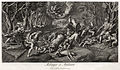 Meleager et Atalanta at Calydonian Boar, by Giulio Romano and François Louis Lonsing (edited by Adam Cuerden) (from Wikipedia:Featured pictures/Culture, entertainment, and lifestyle/Religion and mythology)
 -

-
-
 Omer calendar at Counting of the Omer, by Baruch Zvi Ring (from Wikipedia:Featured pictures/Culture, entertainment, and lifestyle/Religion and mythology)
 -
 Giant Suttung and the Dwarfs at Suttungr, by Louis Huard (restored by Adam Cuerden) (from Wikipedia:Featured pictures/Culture, entertainment, and lifestyle/Religion and mythology)
 -
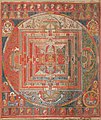 Mandala, unknown author (from Wikipedia:Featured pictures/Culture, entertainment, and lifestyle/Religion and mythology)
 -

-
 Cheyenne sun dance gathering, by Henry Chaufty (edited by Durova) (from Wikipedia:Featured pictures/Culture, entertainment, and lifestyle/Religion and mythology)
 -

-
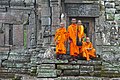 Young monks in Cambodia at Buddhism in Cambodia, by JJ Harrison (from Wikipedia:Featured pictures/Culture, entertainment, and lifestyle/Religion and mythology)
 -
 Devotees during Lathmar Holi, by Narender9 (from Wikipedia:Featured pictures/Culture, entertainment, and lifestyle/Religion and mythology)
 -
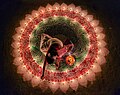 Woman lighting candles for Diwali, by AjoyDutta1997 (edited by Aristeas) (from Wikipedia:Featured pictures/Culture, entertainment, and lifestyle/Religion and mythology)
 -

-
 The Punishment of Loki, by Louis Huard (edited by Adam Cuerden) (from Wikipedia:Featured pictures/Culture, entertainment, and lifestyle/Religion and mythology)
 -
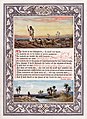 Psalm 23, unknown author (edited by Adam Cuerden) (from Wikipedia:Featured pictures/Culture, entertainment, and lifestyle/Religion and mythology)
 -

-
 Nias megalith, by Ludwig Borutta (edited by Durova) (from Wikipedia:Featured pictures/Culture, entertainment, and lifestyle/Religion and mythology)
 -
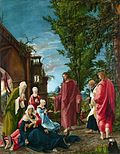
-
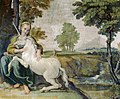 A Virgin with a Unicorn, by Domenichino (from Wikipedia:Featured pictures/Culture, entertainment, and lifestyle/Religion and mythology)
 -
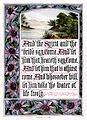 Revelation 22:17 at Book of Revelation, by Joseph Martin Kronheim (edited by Adam Cuerden) (from Wikipedia:Featured pictures/Culture, entertainment, and lifestyle/Religion and mythology)
 -
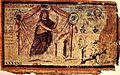 Achilles sacrificing to Zeus for Patroclus' safe return at Ambrosian Iliad, unknown author (from Wikipedia:Featured pictures/Culture, entertainment, and lifestyle/Religion and mythology)
 -
 Giant Skrymir and Thor at Útgarða-Loki, by Louis Huard (edited by Adam Cuerden) (from Wikipedia:Featured pictures/Culture, entertainment, and lifestyle/Religion and mythology)
 -

-
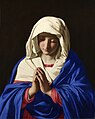
-
 The Flight of the Prisoners at Babylonian captivity, by James Tissot (from Wikipedia:Featured pictures/Culture, entertainment, and lifestyle/Religion and mythology)
 -
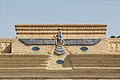 Faravahar on the Fire Temple of Yazd, by Bgag (from Wikipedia:Featured pictures/Culture, entertainment, and lifestyle/Religion and mythology)
 -

-
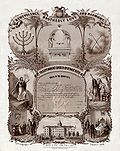 B'nai B'rith membership certificate, by Louis Kurz (edited by Durova and Adam Cuerden) (from Wikipedia:Featured pictures/Culture, entertainment, and lifestyle/Religion and mythology)
 -
-

-

-
-
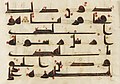 Folio from a Quran, unknown author (from Wikipedia:Featured pictures/Culture, entertainment, and lifestyle/Religion and mythology)
 -
 Woman lighting a diyo during Tihar, by Mithun Kunwar (edited by Radomianin) (from Wikipedia:Featured pictures/Culture, entertainment, and lifestyle/Religion and mythology)
 -
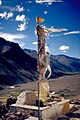 Tibetan prayer flag, by Moumine (from Wikipedia:Featured pictures/Culture, entertainment, and lifestyle/Religion and mythology)
 -
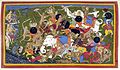 Battle at Lanka, Ramayana, by Sahibdin (from Wikipedia:Featured pictures/Culture, entertainment, and lifestyle/Religion and mythology)
 -

-
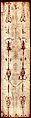 Shroud of Turin, by Giuseppe Enrie (from Wikipedia:Featured pictures/Culture, entertainment, and lifestyle/Religion and mythology)
 -

-

-
-
 A Word of Comfort caricature at Joseph Priestley, by Dent William (edited by Durova) (from Wikipedia:Featured pictures/Culture, entertainment, and lifestyle/Religion and mythology)
 -
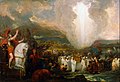 Joshua passing the River Jordan with the Ark of the Covenant, by Benjamin West (from Wikipedia:Featured pictures/Culture, entertainment, and lifestyle/Religion and mythology)
 -
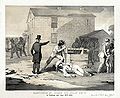 Martyrdom of Joseph and Hiram Smith at Death of Joseph Smith, by G.W. Fasel and Charles G. Crehen (edited by Adam Cuerden) (from Wikipedia:Featured pictures/Culture, entertainment, and lifestyle/Religion and mythology)
 -

-


 Related portals


 Featured article

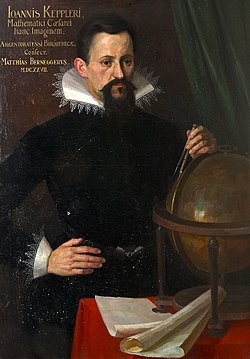
Johannes Kepler (/ˈkɛplər/; German: [joˈhanəs ˈkɛplɐ, -nɛs -] ⓘ; 27 December 1571 – 15 November 1630) was a German astronomer, mathematician, astrologer, natural philosopher and writer on music. He is a key figure in the 17th-century Scientific Revolution, best known for his laws of planetary motion, and his books Astronomia nova, Harmonice Mundi, and Epitome Astronomiae Copernicanae, influencing among others Isaac Newton, providing one of the foundations for his theory of universal gravitation. The variety and impact of his work made Kepler one of the founders and fathers of modern astronomy, the scientific method, natural and modern science. He has been described as the "father of science fiction" for his novel Somnium. (Full article...)
Top 10 WikiProject Religion Popular articles of the month
-

Pope Francis (born Jorge Mario Bergoglio; 17 December 1936) is the head of the Catholic Church and sovereign of the Vatican City State. He is the first pope from the Society of Jesus (the Jesuit Order), the first from the Americas and the Southern Hemisphere, and the first born or raised outside Europe since the 8th-century Syrian pope Gregory III. (Full article...) -
Bob Dylan (legally Robert Dylan; born Robert Allen Zimmerman, May 24, 1941) is an American singer-songwriter. Considered one of the greatest songwriters of all time, Dylan has been a major figure in popular culture over his 60-year career. With an estimated figure of more than 125 million records sold worldwide, he is one of the best-selling musicians of all-time. Dylan added increasingly sophisticated lyrical techniques to the folk music of the early 1960s, infusing it "with the intellectualism of classic literature and poetry". His lyrics incorporated political, social and philosophical influences, defying pop music conventions and appealing to the burgeoning counterculture. (Full article...) -
Kumbh Mela (Sanskrit: Kumbha Mēlā , pronounced [kʊˈmbʱᵊ melaː]; lit. 'festival of the Sacred Pitcher') is an important Hindu pilgrimage, celebrated approximately every 6 or 12 years, correlated with the partial or full revolution of Jupiter. Kumb Mela is of three types: Maha Kumbh Mela (Grand Kumbh Festival) held every 144 years only at Prayagraj at the Triveni Sangam confluence of three sacred rivers Ganges, Yamuna and Saraswati; Purna Kumbh Mela (Full Kumbh Festival) held every 12 years at one of the four sacred places Prayagraj, Haridwar, Nasik and Ujjain; Ardh Kumbh Mela (Half Kumbh Festival) held every six years at one of the two sacred places Prayagraj and Haridwar. (Full article...) -
The Holocaust (/ˈhɒləkɔːst/ ⓘ), known in Hebrew as the Shoah (שואה), was the genocide of European Jews during World War II. Between 1941 and 1945, Nazi Germany and its collaborators systematically murdered some six million Jews across German-occupied Europe, around two-thirds of Europe's Jewish population. The murders were carried out primarily through mass shootings and poison gas in extermination camps, chiefly Auschwitz-Birkenau, Treblinka, Belzec, Sobibor, and Chełmno in occupied Poland. Separate Nazi persecutions killed a similar or larger number of non-Jewish civilians and prisoners of war (POWs); the term Holocaust is sometimes used to include the murder and persecution of non-Jewish groups. (Full article...) -
Thomas Cruise Mapother IV (born July 3, 1962) is an American actor and producer. Regarded as a Hollywood icon, he has received various accolades, including an Honorary Palme d'Or and three Golden Globe Awards, in addition to nominations for four Academy Awards. His films have grossed over $12 billion worldwide, placing him among the highest-grossing actors of all time. One of Hollywood's most bankable stars, he is consistently one of the world's highest-paid actors. (Full article...) -
Aga Khan (Persian: آقاخان; Arabic: آغا خان; also transliterated as Aqa Khan and Agha Khan) is a title held by the Imām of the Nizari Ismāʿīli Shias. From 1957 to 2025, the holder of the title was the 49th hereditary Imām, Prince Shah Karim al-Hussaini, Aga Khan IV (1936–2025). The current holder of the title is the 50th hereditary Imām, Prince Shah Rahim al-Hussaini Aga Khan, The Aga Khan V since 4th February 2025. (Full article...)
-

Share of over-fifteen-year-old population that reportedly have never drunk alcohol (interactive version). Global average is 45%.
Teetotalism is the practice of voluntarily abstaining from the consumption of alcohol, specifically in alcoholic drinks. A person who practices (and possibly advocates) teetotalism is called a teetotaler (US) or teetotaller (UK), or said to be teetotal. Globally, in 2016, 57% of adults did not drink alcohol in the past 12 months, and 44.5% had never consumed alcohol. A number of temperance organisations have been founded in order to promote teetotalism and provide spaces for nondrinkers to socialise. (Full article...) -
Martin Luther King Jr. (born Michael King Jr.; January 15, 1929 – April 4, 1968) was an American Baptist minister, activist, and political philosopher who was one of the most prominent leaders in the civil rights movement from 1955 until his assassination in 1968. He advanced civil rights for people of color in the United States through the use of nonviolent resistance and nonviolent civil disobedience against Jim Crow laws and other forms of legalized discrimination. (Full article...) -
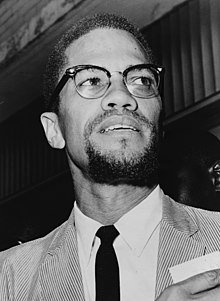
Malcolm X (born Malcolm Little, later el-Hajj Malik el-Shabazz; May 19, 1925 – February 21, 1965) was an African American revolutionary, Muslim minister and human rights activist who was a prominent figure during the civil rights movement until his assassination in 1965. A spokesman for the Nation of Islam (NOI) until 1964 after which he left the movement, he was a vocal advocate for Black empowerment and the promotion of Islam within the African American community. A controversial figure accused of preaching violence, Malcolm X is also a widely celebrated figure within African American and Muslim communities for his pursuit of racial justice. (Full article...) -
Artificial intelligence (AI) refers to the capability of computational systems to perform tasks typically associated with human intelligence, such as learning, reasoning, problem-solving, perception, and decision-making. It is a field of research in computer science that develops and studies methods and software that enable machines to perceive their environment and use learning and intelligence to take actions that maximize their chances of achieving defined goals. Such machines may be called AIs. (Full article...)


 Subcategories

Topics
| Conceptions of God |
| ||||||||||||
|---|---|---|---|---|---|---|---|---|---|---|---|---|---|
| Existence of God |
| ||||||||||||
| Theology |
| ||||||||||||
(by date active) |
| ||||||||||||
| Related topics | |||||||||||||


