Portal:Stars
IntroductionA star is a luminous spheroid of plasma held together by self-gravity. The nearest star to Earth is the Sun. Many other stars are visible to the naked eye at night; their immense distances from Earth make them appear as fixed points of light. The most prominent stars have been categorised into constellations and asterisms, and many of the brightest stars have proper names. Astronomers have assembled star catalogues that identify the known stars and provide standardized stellar designations. The observable universe contains an estimated 1022 to 1024 stars. Only about 4,000 of these stars are visible to the naked eye—all within the Milky Way galaxy. A star's life begins with the gravitational collapse of a gaseous nebula of material largely comprising hydrogen, helium, and trace heavier elements. Its total mass mainly determines its evolution and eventual fate. A star shines for most of its active life due to the thermonuclear fusion of hydrogen into helium in its core. This process releases energy that traverses the star's interior and radiates into outer space. At the end of a star's lifetime as a fusor, its core becomes a stellar remnant: a white dwarf, a neutron star, or—if it is sufficiently massive—a black hole. Stellar nucleosynthesis in stars or their remnants creates almost all naturally occurring chemical elements heavier than lithium. Stellar mass loss or supernova explosions return chemically enriched material to the interstellar medium. These elements are then recycled into new stars. Astronomers can determine stellar properties—including mass, age, metallicity (chemical composition), variability, distance, and motion through space—by carrying out observations of a star's apparent brightness, spectrum, and changes in its position in the sky over time. Stars can form orbital systems with other astronomical objects, as in planetary systems and star systems with two or more stars. When two such stars orbit closely, their gravitational interaction can significantly impact their evolution. Stars can form part of a much larger gravitationally bound structure, such as a star cluster or a galaxy. (Full article...) Selected star - Photo credit: NASA
Canopus (/kəˈnoʊpəs/; α Car, α Carinae, Alpha Carinae) is the brightest star in the southern constellation of Carina, and the second brightest star in the night-time sky, after Sirius. Canopus's visual magnitude is −0.72, and it has an absolute magnitude of −5.65. Canopus is a supergiant of spectral type F. Canopus is essentially white when seen with the naked eye (although F-type stars are sometimes listed as "yellowish-white"). It is located in the far southern sky, at a declination of −52° 42' (2000) and a right ascension of 06h24.0m. Its name comes from the mythological Canopus, who was a navigator for Menelaus, king of Sparta. Canopus is the most intrinsically bright star within approximately 700 light years, and it has been the brightest star in Earth's sky during three different epochs over the past four million years. Other stars appear brighter only during relatively temporary periods, during which they are passing the Solar System at a much closer distance than Canopus. About 90,000 years ago, Sirius moved close enough that it became brighter than Canopus, and that will remain the case for another 210,000 years. But in 480,000 years, Canopus will once again be the brightest, and will remain so for a period of about 510,000 years. Selected article - Photo credit: user:Lviatour
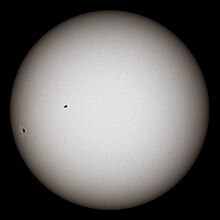
A corona is a type of plasma "atmosphere" of the Sun or other celestial body, extending millions of kilometers into space, most easily seen during a total solar eclipse, but also observable in a coronagraph. The Latin root of the word corona means crown. The high temperature of the corona gives it unusual spectral features, which led some to suggest, in the 19th century, that it contained a previously unknown element, "coronium". These spectral features have since been traced to highly ionized iron (Fe-XIV) which indicates a plasma temperature in excess of 106 kelvin. The fact that the Sun has a million degree corona was first discovered by Gotrian in 1939 and Bengt Edlén in 1941 by identifying the coronal lines (observed since 1869) as transitions from low lying metastable levels of the ground configuration of highly ionized metals (the green FeXIV line at 5303 Å, but also the red line FeX at 6374 Å). Light from the corona comes from three primary sources, which are called by different names although all of them share the same volume of space. The K-corona (K for kontinuierlich, "continuous" in German) is created by sunlight scattering off free electrons; Doppler broadening of the reflected photospheric absorption lines completely obscures them, giving the spectral appearance of a continuum with no absorption lines. The F-corona (F for Fraunhofer) is created by sunlight bouncing off dust particles, and is observable because its light contains the Fraunhofer absorption lines that are seen in raw sunlight; the F-corona extends to very high elongation angles from the Sun, where it is called the Zodiacal light. The E-corona (E for emission) is due to spectral emission lines produced by ions that are present in the coronal plasma; it may be observed in broad or forbidden or hot spectral emission lines and is the main source of information about the corona's composition. The sun's corona is much hotter (by a factor of nearly 200) than the visible surface of the Sun: the photosphere's average temperature is 5800 kelvin compared to the corona's one to three million kelvin. Selected image - Photo credit: NASA
The Pinwheel Galaxy (also known as Messier 101 or NGC 5457) is a face-on spiral galaxy about 27 million light-years away in the constellation Ursa Major, discovered by Pierre Méchain. On February 28, 2006, NASA and the ESA released a very detailed image of Pinwheel Galaxy, which was the largest and most detailed image of a galaxy by Hubble Space Telescope at the time. The image was composed from 51 individual exposures, plus some extra ground-based photos. M101 is a relatively large galaxy compared to the Milky Way. With a diameter of 170,000 light-years it is nearly twice the size of the Milky Way. It has a disk mass on the order of 100 billion solar masses, along with a small bulge of about 3 billion solar masses. Did you know?
SubcategoriesTo display all subcategories click on the ►
Selected biography - Photo credit: Uploaded by User:Maksim
Hipparchus was born in Nicaea (now Iznik, Turkey), and probably died on the island of Rhodes. He is known to have been a working astronomer at least from 147 to 127 BC. Hipparchus is considered the greatest ancient astronomical observer and, by some, the greatest overall astronomer of antiquity. He was the first whose quantitative and accurate models for the motion of the Sun and Moon survive. For this he certainly made use of the observations and perhaps the mathematical techniques accumulated over centuries by the Chaldeans from Babylonia. He developed trigonometry and constructed trigonometric tables, and he has solved several problems of spherical trigonometry. With his solar and lunar theories and his trigonometry, he may have been the first to develop a reliable method to predict solar eclipses. His other reputed achievements include the discovery of Earth's precession, the compilation of the first comprehensive star catalog of the western world, and possibly the invention of the astrolabe, also of the armillary sphere, which he used during the creation of much of the star catalogue. It would be three centuries before Claudius Ptolemaeus' synthesis of astronomy would supersede the work of Hipparchus; it is heavily dependent on it in many areas. TopicsThings to do
Related portalsAssociated WikimediaThe following Wikimedia Foundation sister projects provide more on this subject:
Discover Wikipedia using portals |