Purine
Purines include two of the bases in DNA and RNA.
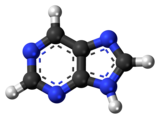
A purine is a heterocyclic aromatic organic compound. It is a pyrimidine ring fused to an imidazole ring. Purines are the most widely occurring nitrogen-containing heterocycles in nature.[1]
Purines and pyrimidines are the two groups of nitrogenous bases, and the two groups of nucleotide bases.
Purines
References
- ↑ Rosemeyer H. 2004. Chemistry & biodiversity. 1, 361.
Simple aromatic rings |
|---|
| 1 ring | | Three-membered | |
|---|
| Five-membered |
- Furan
- Pyrrole
- Imidazole
- Thiophene
- Phosphole
- Pyrazole
- Oxazole
- Isoxazole
- Thiazole
- Isothiazole
- Triazole
- Tetrazole
- Pentazole
|
|---|
| Six-membered | |
|---|
| Seven-membered | |
|---|
| Nine-membered | |
|---|
| 18-membered | |
|---|
|
|---|
| 2 rings | | Five + Five |
- Diazapentalene
- Thienothiophene
- Trithiapentalene
|
|---|
| Five + Six |
- Benzofuran
- Isobenzofuran
- Indole
- Isoindole
- Benzothiophene
- Benzo(c)thiophene
- Benzophosphole
- Benzimidazole
- Purine
- Indazole
- Benzoxazole
- Benzisoxazole
- Benzothiazole
- 5-Aza-7-deazapurine
|
|---|
| Six + Six |
- Naphthalene
- Quinoline
- Isoquinoline
- Quinoxaline
- Quinazoline
- Cinnoline
- Phthalazine
|
|---|
| Five + Seven | |
|---|
|
|---|


 verify (what is
 ?)
?)
